


A taxi isn’t necessarily the problem; uncertainty is. For a straightforward trip across town, it may be a practical choice. But the problems with using taxis for corporate travel tend to surface when pickup availability, receipts, or a tightly timed itinerary matter as much as the ride itself.
That friction is familiar: a car may be harder to coordinate during busy periods, trip records can vary, and an airport pickup, several stops, or a group itinerary leaves more details to manage. The answer isn’t to rule out taxis. It’s to match the transport approach to the journey, keeping simple trips simple and planning more involved travel with care.
This guide explains where taxi-based business travel can create avoidable work, what to consider for expense-policy records and scheduling, and how to decide which journeys can remain taxi-based. It also compares pre-arranged options fairly, including airport transfers, point-to-point travel, and hourly charters, with sedans, SUVs, and Mercedes Sprinter vans for different passenger and luggage needs. You’ll leave with a clearer framework for balancing flexibility, coordination, and a calm arrival.
Key Takeaways
- Assess the problems with using taxis for corporate travel by looking at scheduling, trip records, and vehicle capacity, not just the ride itself.
- Set clear expense and travel-policy guidelines so employees know when a taxi suits the journey and when advance coordination is preferable.
- Compare taxis and pre-arranged chauffeured travel by itinerary complexity, passenger needs, booking approach, and expense workflow.
- Use a five-step checklist to plan the route, timing, group size, policy, and booking method before choosing transport.
- Match airport transfers, point-to-point travel, and hourly charters to the shape of the itinerary for more considered coordination.
Problems with Using Taxis for Corporate Travel: Where Friction Begins
Taxis can be a sensible choice for a short, familiar journey with flexible timing. The difficulty is that business travel rarely follows one pattern: a quick trip between nearby offices has different requirements from an airport arrival, a client meeting with a fixed start time, or travel involving several colleagues and luggage. The problems with using taxis for corporate travel often come from that mismatch, rather than from taxis being inherently unsuitable.
Corporate travel friction means anything that adds avoidable uncertainty or administration to a journey: a possible wait, a gap between pickup and itinerary, incomplete or inconsistent trip records, or a vehicle that cannot comfortably accommodate the passengers and bags. These are potential issues, not guaranteed outcomes. Location, time of day, booking method, local taxi arrangements, and company procedures all shape the experience. The wider discipline of corporate travel management also considers how transport choices fit policy, expenses, and traveler needs.
Quotable takeaway: Taxi travel becomes harder to manage when a journey depends on precise timing, coordinated stops, consistent records, or a known vehicle capacity.
Where taxi availability can disrupt a business itinerary
Demand peaks can make the gap between requesting a taxi and beginning a trip less predictable. An unfamiliar pickup point adds another variable: a traveler arriving at a busy terminal may need to locate the correct collection area, while a driver may need clear instructions to reach it. Neither situation guarantees a delay, but both can complicate planning when there is little room in the schedule.
Consider an employee landing before a meeting across town. If the pickup process takes longer than expected, the time reserved for the journey may shrink. Or picture a visitor leaving a hotel for a presentation with a fixed start time. A taxi may be entirely suitable, but relying on immediate availability leaves less control over the departure plan. Where timing is critical, advance coordination can help align the pickup with the itinerary instead of leaving the traveler to arrange each step as it arises.
Capacity also deserves attention. One traveler with a work bag has different needs from a team carrying presentation materials or airport luggage. A taxi that suits one passenger may not suit a larger group or a fuller load, making vehicle fit part of the planning decision.
Why individual taxi trips can complicate corporate oversight
When employees arrange rides separately, each trip may generate its own receipt, booking record, and expense entry. The detail and format can differ depending on the taxi arrangement and local process. Finance teams may then spend time matching expenses to business purposes, while assistants or travel managers have less of a consolidated view of how journeys were arranged.
Policy oversight can become more difficult across locations, too. One trip may be booked through a company-approved process; another may follow a local practice with different documentation. That does not mean taxi records are always incomplete or policy compliance is impossible. Outcomes depend on the company’s expense procedures and the booking method used. Clear rules on permitted trips, required receipts, and how to record business purpose help create consistency without ruling out taxis where they fit.
How Taxi-Based Business Trips Create Scheduling, Expense, and Duty-of-Care Gaps
A taxi arranged for one leg may solve the immediate transport need, but several separate requests can leave an assistant or travel manager coordinating each pickup, change, and follow-up individually. If a meeting runs late, an airport arrival shifts, or a traveler needs to add a stop, someone may need to arrange another ride and relay the updated plan. The extra work depends on how the company books and manages trips, but it can become more visible across a busy itinerary.
A single ride booking addresses one trip; coordinated journey management accounts for how each leg, change, and traveler fits the wider schedule. That distinction matters for businesses weighing the problems with using taxis for corporate travel against the convenience of booking each ride as needed.
Scheduling gaps across meetings, airports, and multiple stops
A point-to-point journey has a clear origin and destination. A multi-stop day is more involved: a traveler might leave the airport for a client meeting, continue to another office, then return to a hotel. Arranging each leg independently can require repeated coordination, especially when a meeting ends later than planned or the next pickup location changes. Planning the sequence ahead can make responsibilities clearer, though it cannot eliminate traffic or other delays.
For an assistant, the practical question is not simply whether a taxi can make each trip. It’s who will revise the arrangements if the itinerary changes, and how the traveler will know the next step. The U.S. Business Travel Trends resource offers broader context for business travel planning; within an individual company, clear processes help connect transport arrangements to schedules and traveler needs.
Expense records and traveler oversight
Separate taxi trips can produce separate receipts and trip details, and formats or levels of detail may vary with the booking method and location. A traveler might submit each receipt promptly, or finance may need to follow up for a missing business purpose or other required information. Variable fares can also make reconciliation less straightforward when the organization expects an estimate, approval, or consistent record for each journey. These are possible process gaps, not inevitable features of every taxi arrangement.
Clear internal rules can reduce ambiguity. Document how employees book and obtain approval, which details they must submit with receipts, and how they should record exceptions such as a changed destination. Define who reviews the records and who receives itinerary updates. A consistent procedure helps finance reconcile expenses and gives travel managers a practical view of planned journeys without implying that any booking method alone ensures traveler safety.
For journeys that benefit from advance coordination, Sedanz’s airport transfers, point-to-point travel, and hourly charters provide options suited to different itinerary shapes.
Taxis vs. Pre-Arranged Chauffeured Travel: Compare the Right Things
A useful comparison starts with the journey, not a blanket judgment about either option. Taxis can suit short, straightforward trips when local availability, traveler needs, and company policy align. Pre-arranged chauffeured travel may fit better when a pickup is part of a larger plan, such as an airport arrival, a scheduled executive itinerary, or transport for a group.
Consider the differences across four practical areas:
Booking approach: A taxi is commonly arranged for an individual trip; pre-arranged travel is organized around a planned pickup and itinerary.
Itinerary complexity: A simple journey between two nearby locations may be easy to arrange as needed. Several appointments, stops, or coordinated arrivals can call for more planning.
Vehicle choice: Taxi options depend on local supply. A chauffeured booking can be planned around passenger and luggage requirements, with sedan, SUV, and Mercedes Sprinter van options.
Expense workflow: Taxi receipts and trip details depend on the booking method and local process. A company can incorporate pre-arranged journeys into its travel and expense procedures, while still defining how records are submitted and reviewed.
Neither approach is automatically cheaper, faster, safer, or more reliable in every circumstance. The best fit depends on the route, schedule, group, local conditions, and the organization’s own policies. Those factors also help distinguish genuine problems with using taxis for corporate travel from situations where a taxi is simply a practical solution.
When a taxi may be the practical choice
For one employee traveling between nearby offices with flexible timing, arranging a taxi may be a straightforward choice. The itinerary has one destination, the passenger’s needs are simple, and there may be little value in coordinating a more involved plan. A taxi can also suit other uncomplicated local trips if supply is suitable and company rules permit that booking method.
Consider the context before making it the default. Local availability can vary, and the needs of a traveler carrying presentation materials may differ from those of someone with only a small bag. A clear policy lets employees use taxis for appropriate journeys without treating ordinary taxi use as inherently unsuitable for business.
When pre-arranged chauffeured transport may fit better
An airport transfer can be arranged as part of a planned arrival rather than left as a separate task after landing. For an executive schedule with several planned stops, an hourly charter can align transportation with the shape of the day. Point-to-point travel, by contrast, suits a planned journey between two locations.
Vehicle selection can also reflect the group and its luggage: a sedan may suit a smaller party, while an SUV or Mercedes Sprinter van may better match different passenger or baggage requirements. Pre-arranging transport gives the company a way to plan these details in advance, without implying that traffic or schedule changes can be eliminated.
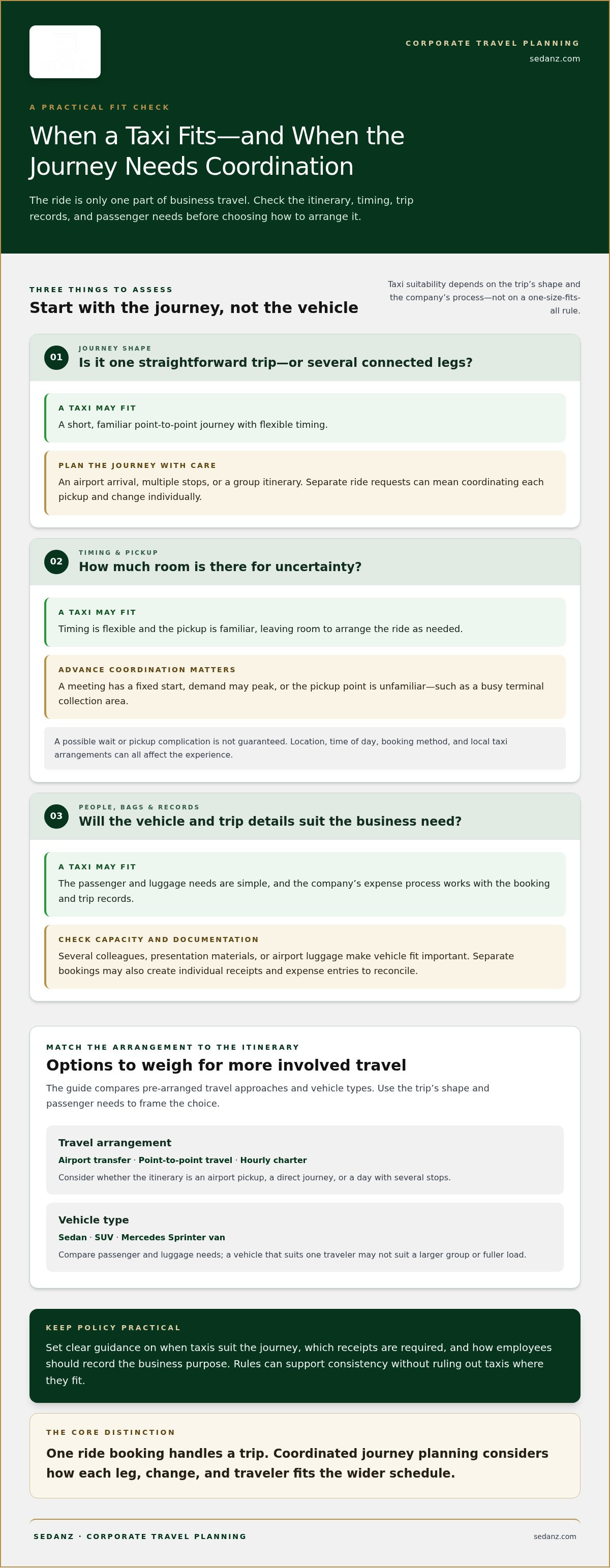
How to Decide When Corporate Travel Needs More Than a Taxi
A practical transport policy doesn’t need to prohibit taxis. It should help employees and travel coordinators match the booking approach to each journey, with a clear alternative when timing, group size, or itinerary complexity calls for advance planning. Use this five-step checklist to make that decision consistent.
A journey-based checklist for travel managers
- Map the itinerary. Record the pickup point, destination, connections, and meeting sequence. A single trip between two familiar locations may be simple to arrange independently; a day with several appointments may need a plan for each leg and how the traveler moves between them.
- Assess the timing. Note departure times, fixed meeting starts, airport arrival details, and how much flexibility the schedule allows. Consider whether a missed connection or a late-running meeting would affect the next part of the day. Planning transport in advance can organize a pickup, but can’t remove traffic or other delays.
- Count travelers and their needs. Include passenger numbers, luggage, work materials, and accessibility requirements in the transport decision. A vehicle that suits one traveler may not suit a team with bags, so consider capacity before booking rather than at pickup.
- Set the policy. Specify when employees may book taxis, what expense documentation to submit, and which trips need authorization or advance coordination. Include an exception process for disruptions, late meetings, or urgent changes, so staff know how to act without guessing.
- Select the booking approach. Choose based on the route, timing, traveler needs, and policy. A taxi may suit a flexible, uncomplicated trip; a planned airport arrival, multi-stop schedule, or group journey may call for a pre-arranged option.
Make the transport policy clear and usable
Keep the guidance easy to apply at the moment of booking. State approved methods, receipt requirements, approval levels, and how to document exceptions. Then review recurring journeys: if employees repeatedly arrange the same airport transfer or office-to-office route separately, a more coordinated approach may reduce repeated planning and create a clearer process.
For location-specific planning, the executive transportation guide for New York offers a closer look at considerations for navigating the city. Applying the same journey-based thinking across your own routes can help distinguish routine trips from those that benefit from advance coordination.
If your itinerary calls for a planned airport transfer, point-to-point journey, or hourly charter, explore Sedanz corporate transportation as a considered option.
A More Consistent Corporate Travel Plan with Sedanz
Some business journeys benefit from more structure than an individual ride booking can provide. Sedanz offers pre-arranged chauffeured transportation for companies planning airport arrivals, defined transfers, and itineraries that include several stops. Matching the service and vehicle to the journey can help make the transport plan clearer from the outset, while leaving room for the realities of travel.
This approach doesn’t mean every taxi trip needs replacing. It gives travel planners another option for the journeys where coordination matters, particularly when the problems with using taxis for corporate travel would stem from managing multiple separate legs, group requirements, or a tightly planned schedule.
Match the service to the shape of the journey
Each service fits a different itinerary. Airport transfers provide a pre-arranged option for travel to or from an airport, useful when transport is one part of a planned arrival or departure. For a journey with a clear start and end point, a point-to-point transfer suits the direct route without requiring a broader itinerary.
For a business day with several planned stops, an hourly charter can align transportation with the sequence of appointments. For example, a traveler moving between a hotel, a client office, and a dinner venue may find it useful to plan the day’s transport as a connected itinerary rather than treating each leg as a separate request. The right choice depends on the journey’s structure, not simply on the destination.
Coordinate travel across destinations and passenger needs
Passenger and luggage requirements help determine which vehicle best fits the plan. Sedans can suit individual travelers or smaller parties; SUVs and Mercedes Sprinter vans offer other options for different group and baggage needs. Considering these details before the trip helps align the vehicle choice with the people and items traveling, rather than leaving capacity to chance.
For organizations arranging transport in more than one destination, Sedanz’s vetted international affiliate network supports global transportation bookings. That can help businesses coordinate ground travel across locations through a connected booking relationship. For a closer look at the role of chauffeured transportation in executive journeys, see this chauffeur service guide for executive travel.
A considered transport plan doesn’t need to make every trip complex. It simply matches the service to the itinerary, the vehicle to the travelers, and the level of planning to the needs of the day. For upcoming business journeys, plan corporate transportation with Sedanz.
Make Your Next Business Journey Easier to Plan
The problems with using taxis for corporate travel are easier to address when transport decisions are made before a busy travel day begins. Choose an upcoming journey and identify where uncertainty is most likely to arise: a tight connection, a changing schedule, or several people traveling together. Then decide what should be arranged in advance and what employees can handle independently.
That single review can become a practical starting point for a clearer travel playbook. Record the decision, give the traveler a straightforward process, and revisit it after the trip. Over time, the company can refine its approach around real itinerary needs rather than relying on a one-size-fits-all rule.
For journeys that call for thoughtful coordination, Sedanz can help you plan transportation around the day ahead. Plan your corporate transportation with Sedanz, and take the next trip forward with greater clarity and confidence.
Frequently Asked Questions
Are taxis appropriate for every type of corporate journey?
No. A taxi can work well for a simple trip, but not every journey has the same requirements. The problems with using taxis for corporate travel are more likely to matter when a trip involves several colleagues, multiple destinations, limited schedule flexibility, or a pickup that needs coordinating with another travel leg. Consider the full itinerary, not just the distance from A to B, and apply your company’s travel rules before choosing.
Is a taxi always less expensive than pre-arranged chauffeured transportation?
No, there isn’t a universal cost advantage. The final amount for a taxi can depend on the route, local fare rules, and the circumstances of the trip; pre-arranged transportation is priced according to its own booking terms. Compare like with like by considering the planned journey, passenger needs, and any additional legs rather than judging from a single short ride. Your organization’s travel policy can set which option is appropriate for each situation.
Can employees claim taxi rides as business expenses?
Often, an employee can submit a taxi fare for business expense review if the journey serves a legitimate work purpose and follows company policy. Reimbursement and tax treatment depend on the employer’s rules and the applicable jurisdiction, so a receipt alone doesn’t guarantee approval or deductibility. Employees should record why they traveled, the relevant meeting or work activity, and any personal portion of a mixed-purpose journey, then follow finance’s submission process.
What information should employees keep after a taxi trip?
Keep the receipt or other proof of payment, along with the trip date, pickup and drop-off points, fare, and business purpose. Note the related client meeting, office visit, or airport connection so finance can understand why the expense was incurred. If the route or fare changed from what was expected, briefly explain why. Submit records through the company’s usual process and retain copies until the expense has been reviewed.
How much should a company budget for corporate taxi travel?
Build the budget from your own travel history rather than relying on one assumed fare. Review representative routes, destinations, time periods, and seasonal or event-related travel, then compare actual receipts over time. Separate routine local rides from airport journeys or trips with several legs, since they may have different cost patterns. Set a review cycle so finance can adjust the allowance when routes, travel volume, or company policy changes.
Can a taxi accommodate several business travelers and their luggage?
Sometimes, but it depends on the vehicle available locally, the number of passengers, and how much luggage or work equipment they carry. A group should consider bags, presentation materials, and any mobility needs before assuming one vehicle will fit everyone comfortably. If capacity is uncertain, follow company guidance for arranging suitable transport rather than splitting a group unexpectedly. Planning the vehicle requirement early can also help keep the team’s departure coordinated.
What should employees do if a taxi is unavailable after a meeting?
Follow the company’s contingency process first, including any approved booking method and spending limit. Let the designated travel contact or manager know if the delay affects another appointment or onward connection. If no process exists, employees should move to an appropriate staffed public area, keep colleagues informed, and record any replacement transport expense and the reason for it. A clear fallback procedure helps employees respond calmly without making unsupported commitments on the company’s behalf.