


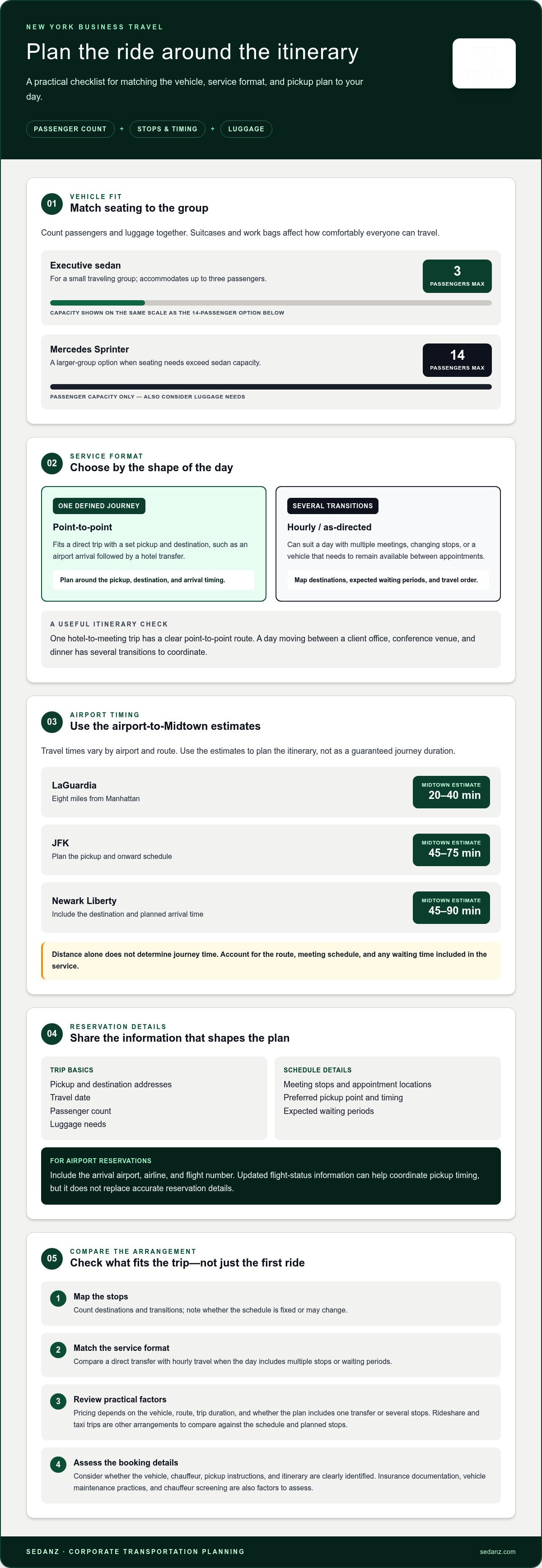
For New York travel, an executive sedan service accommodates up to three passengers. Hourly, as-directed travel can suit a business day with several meetings or changing plans. The right vehicle also depends on how much luggage the group is carrying.
Choosing a vehicle is only one part of planning a smooth trip. Coordinating airport pickups, meeting stops, and the time between appointments can keep the day orderly, especially when the schedule involves more than a simple point-to-point journey.
This article explains how hourly and as-directed transportation works, what to consider when matching passengers and luggage to a vehicle, and how airport and corporate trips can be arranged. You’ll also learn how chauffeured transportation can support meeting days and trade-show travel, so you can choose an arrangement that fits the itinerary rather than forcing the itinerary around the ride.
Key Takeaways
- Match the vehicle to both your passenger count and luggage so the group can travel comfortably without compromising the itinerary.
- For a day with several appointments or changing stops, consider hourly or as-directed travel rather than planning each journey as a separate point-to-point trip.
- Allow for varied airport-to-Midtown travel times: estimates range from 20-40 minutes from LaGuardia, 45-75 minutes from JFK, and 45-90 minutes from Newark Liberty.
- Plan airport pickups around the arrival, meeting schedule, and any waiting time included in the service, then choose the arrangement that best fits the day.
- Compare the trip’s needs, from a single airport transfer to a full schedule of corporate stops, to identify the most suitable chauffeured option.
Corporate transportation for meetings, trade shows, and airport pickups
Corporate trips often combine airport arrivals, scheduled meetings, and event venues. An executive sedan service can connect these stops through a planned itinerary, with the vehicle choice based on passenger and luggage needs.
Executive Sedans for Business Trips
For a meeting day, plan the route around your arrival time, appointment locations, and any stops in between. In New York, a sedan accommodates up to three passengers, making it suitable for a small traveling group. Count suitcases and work bags before choosing a vehicle, since luggage affects how comfortably everyone can travel.
Service Comparisons and Pricing Factors
The Internal Revenue Service describes executive car service as a luxury vehicle with a chauffeur who picks up and drops off the traveler. According to the U.S. Government Publishing Office, state-licensed limousine services typically use relatively new luxury-model vehicles and charge by time. Rideshare and taxi trips are other transportation arrangements; compare how each fits your schedule and planned stops. Pricing depends on factors such as vehicle, route, trip duration, and whether you need one transfer or several stops.
Booking an Executive Sedan
To book, provide the pickup and destination addresses, travel date, passenger count, luggage needs, and meeting stops. For an airport reservation, include the airline and flight number to identify the arrival using flight-status information. Set the pickup point and timing around your itinerary. Clear details help match the vehicle and schedule to your trip.
Airport travel times vary by airport and route. Midtown estimates are 20-40 minutes from LaGuardia, 45-75 minutes from JFK, and 45-90 minutes from Newark Liberty. LaGuardia is eight miles from Manhattan, but distance alone doesn’t determine the journey time. Include the destination and planned arrival time when organizing airport transportation, then allow the itinerary to account for the route.
Flight tracking is a planning tool, not a substitute for sharing accurate reservation details. Provide the flight number and arrival airport, then use updated flight information to coordinate when the pickup should take place. For example, a JFK arrival followed by a Midtown meeting calls for planning both the airport pickup and the onward schedule. For a larger group, compare luggage and seating needs with vehicle capacity: a Mercedes Sprinter accommodates up to 14 passengers, while the sedan suits up to three.
Executive and corporate chauffeured transportation
Yes, chauffeured transportation can cover airport transfers and hourly bookings. A direct pickup suits a single destination, while hourly travel can accommodate a day with several stops.
Hourly and Point-to-Point Chauffeur Service
The Internal Revenue Service describes executive car service as a luxury vehicle with a chauffeur who picks up and drops off the traveler. Point-to-point transportation follows a defined journey, such as an airport arrival followed by a hotel transfer. Hourly service suits schedules with multiple meetings or changing stops. Choose the arrangement by mapping your itinerary first: count destinations, note expected waiting periods, and decide whether the vehicle needs to remain available between appointments.
For example, a traveler going directly from a hotel to one meeting has a clear point-to-point itinerary. A day moving between a client office, conference venue, and dinner has several transitions to coordinate. This distinction helps ensure the booking reflects the actual schedule, not just the first pickup and final destination.
Chauffeur Professionalism and Punctuality
Professionalism shows in the details of a business arrival: clear communication, courteous conduct, and familiarity with the planned pickup point. Punctuality also depends on realistic scheduling. Share meeting addresses, flight details, and your preferred pickup location when arranging transportation. This gives the itinerary structure and helps avoid confusion when an office entrance differs from the building’s main address.
For a corporate day, organize the schedule in travel order and include time for transitions between locations. A chauffeur can then follow a defined plan rather than rely on last-minute directions. For a limousine service, as with any chauffeured booking, professional conduct and punctual service are important criteria to assess alongside the route and vehicle.
Safety, Insurance, and Chauffeur Vetting
A safety review begins with the vehicle and the person driving it. Consider whether your transportation booking clearly identifies the vehicle, chauffeur, and pickup details before travel. Insurance documentation, vehicle maintenance practices, and chauffeur screening are also useful factors when assessing corporate transportation. These considerations help distinguish a carefully managed trip from one planned only around the destination.
For a business travel policy, record the information employees need to use consistently, such as the reservation contact, pickup instructions, and approval process. Keep the traveler’s itinerary aligned with the booking so colleagues know where the trip begins and ends. Clear records support coordination without assumptions about licensing rules or screening standards.
Included Services and Availability
Airport transfers and hourly bookings suit different schedules, and the reservation should make that distinction clear. An airport journey centers on an arrival and destination; hourly travel centers on a block of time and planned stops. The U.S. Government Publishing Office reports that state-licensed limousine services typically use relatively new luxury-model vehicles and charge customers based on time. This helps explain why the booking structure matters when comparing trip types.
Corporate accounts can organize travel details and approval practices for employees who book recurring meetings or airport journeys. Set out the traveler, pickup point, destination, and whether additional stops are part of the itinerary. For an upcoming business trip, review chauffeured transportation options against those needs, then select the arrangement that fits the schedule.
Hourly service and as-directed travel
Hourly travel suits an itinerary with several stops, while point-to-point transportation serves a defined journey. Choose based on how much the schedule may change between the first pickup and final destination.
How Hourly Travel Works
With an hourly arrangement, the vehicle and chauffeur are reserved for a block of time. This can suit a business day with a morning meeting, a client visit, and an evening event. Rather than arranging a separate journey for every stop, map the day’s destinations and consider how much flexibility the schedule needs.
As-directed travel is useful when the next destination may shift during the day. A meeting might finish early, for example, or a client may request a stop before the evening venue. Share the likely route and priorities when booking, then communicate changes as the itinerary develops. This helps align the service with the day.
When Point-to-Point Makes Sense
A point-to-point trip is straightforward when the pickup and destination are established. A traveler going from an airport to a hotel and spending the day there may need only that direct journey. Booking a vehicle for the full day could be unnecessary if no other stops or changes are expected.
Compare the number of planned journeys with the time between them. If your schedule includes several appointments across a city, hourly travel may reduce the need to coordinate each leg individually. If there is one destination and no planned return trip, a direct booking may be more practical. Let the itinerary determine the arrangement, not the label.
Planning an As-Directed Itinerary
Before booking, list the known addresses in travel order. Mark fixed appointments, flexible stops, and any point where the schedule could change. A conference day might include a hotel pickup, a venue, a nearby client office, and a return journey. This outline gives the transportation provider a useful picture of the day without suggesting every detail is final.
Keep the essential instructions clear: pickup location, destination, timing, and how you prefer to communicate route changes. A special event may require a different sequence than an ordinary workday, especially if guests have separate arrival points. A well-organized journey depends on a coherent plan as well as the vehicle.
Choosing the Right Vehicle and Service
Match the vehicle to the passengers and their belongings, then consider whether the itinerary needs flexibility. A solo traveler with one meeting has different needs from colleagues moving between appointments with presentation materials. Explain the schedule’s fixed points and likely changes so the transportation booking reflects the real journey.
Finally, review the plan from the chauffeur’s perspective. A clear pickup address, ordered stops, and a defined final destination make the day easier to follow. If the route changes, give the updated instruction directly rather than relying on an old itinerary. That simple step helps keep an as-directed trip coordinated and composed.
Luxury sedan passenger and luggage capacity
In New York, a luxury sedan accommodates up to three passengers. Vehicle choice should account for both the group and its luggage, since passenger capacity alone doesn’t describe the full travel setup.
Passenger Capacity
A sedan suits a small party: the New York executive sedan accommodates up to three passengers. For a group larger than that, consider an SUV, which accommodates up to six, or a Mercedes Sprinter, which accommodates up to 14. These capacities help narrow the vehicle choice before planning the pickup, especially when colleagues are traveling together.
Count every traveler, including the person arranging the trip, before selecting a vehicle. A three-person group fits the sedan’s stated passenger capacity, while a four-person group needs a larger option. For a team heading to a morning meeting, matching the vehicle to the headcount helps keep the group together without exceeding capacity.
Luggage Capacity
Passenger count is only part of the decision. A traveler with several suitcases has different space needs from three colleagues carrying briefcases. Before booking, list the travelers’ bags by type, such as checked suitcases, carry-ons, and work materials. Consider both the group size and the amount of luggage when choosing a vehicle.
Three passengers may fit the sedan’s capacity, but their luggage still matters. A group traveling to an airport with multiple suitcases may prefer to compare the SUV or Mercedes Sprinter with the sedan. Share passenger count and luggage details together, rather than treating them as separate planning questions. This helps ensure the pickup plan reflects what the group will bring.
The available vehicle types include luxury sedans, SUVs, and Mercedes Sprinter vans. These options differ in passenger capacity, so choose based on the group’s headcount and belongings. Specific amenity details should not be assumed from the vehicle category alone. For business travel, focus first on fit: how many people are riding, how much luggage they’ll carry, and whether the group needs to arrive together.
A practical selection process is simple. First, confirm the number of passengers. Next, estimate luggage by counting each traveler’s bags and noting larger items, such as presentation materials. Finally, compare the resulting needs with the vehicle capacities: up to three passengers in a sedan, up to six in an SUV, or up to 14 in a Mercedes Sprinter. These figures apply to New York travel.
Comfort also depends on avoiding a tight fit. A sedan may suit a small group with modest luggage, while a larger vehicle can better accommodate more passengers or belongings. For an airport pickup, make the vehicle decision before finalizing the itinerary, so passenger and luggage needs inform the transportation plan from the start.
What services are included in executive sedan transportation?
An executive sedan journey is organized around the pickup, destination, vehicle, and itinerary. The arrangement depends on whether the trip is a direct transfer, an airport pickup, or travel with several planned stops. For a useful booking, identify the trip type first, then provide the addresses, passenger count, and timing requirements.
For an airport journey, include the airport, airline, flight details, arrival time, and destination in your reservation. At JFK, international arrivals include 60 minutes of free wait time. That allowance is useful when coordinating an overseas arrival, but the pickup location and onward destination still belong in the travel plan.
A traveler arriving at JFK for a Midtown appointment, for example, needs to coordinate the airport pickup with the meeting schedule. A direct journey has a clear destination, while a day with multiple appointments needs a route that accounts for each stop. Setting out these details helps define the transportation arrangement before travel begins.
Useful reservation details include:
- Pickup and destination addresses, including the preferred entrance or meeting point.
- Passenger count and luggage needs, so the vehicle can suit the traveling party.
- Flight information for an airport arrival, including the airport and arrival details.
- Planned stops and appointment times for a journey with several destinations.
These details describe the trip, not additional amenities. Don’t assume vehicle features, refreshments, baggage handling, or other provisions based on the words “executive” or “luxury.” Focus on the stated transportation arrangement and the practical needs of the journey. A traveler heading straight from an airport to one office, for instance, has different requirements from a group attending several meetings.
Before confirming a reservation, read the itinerary as the traveler will experience it. Start with the pickup point, then follow each destination in order, including the final drop-off. Make sure the flight details match the arrival airport and that planned stops are in the correct sequence. This review can reveal missing addresses or unclear timing before the trip.
For an international arrival at JFK, account for the included 60-minute wait period in the pickup plan. For other journeys, organize the schedule around the actual route and purpose, such as an airport-to-office transfer or a series of corporate stops. Arrange your executive transportation with the itinerary details ready.
Sedanz: Airport Transfers
Sedanz provides Airport Transfers for travelers planning a direct journey between the airport and their destination. For a business itinerary with several appointments, Hourly Charters can accommodate travel between scheduled stops, while Point-to-Point Transfers suit a defined route. Luxury Sedan Service is an option for smaller parties whose passenger and luggage needs fit a sedan.
Choose an arrangement based on your itinerary, pickup details, passenger count, and luggage. An airport arrival followed by one destination calls for a different plan than a day of meetings across several locations. Sharing these details helps match transportation to your journey.
For your next business trip, contact Sedanz to discuss your transportation needs.
Plan Your Next Business Journey with Confidence
Your transportation plan can support the working day, not compete with it. Before your next trip, decide what needs to stay fixed and where flexibility matters. This clarity helps shape a journey around your schedule and gives each transition a clear purpose.
An executive sedan service can be part of a considered business itinerary, whether the priority is a composed arrival or smooth movement between appointments. Match the transportation arrangement to the day ahead, with the route and timing ready to share.
Sedanz offers Airport Transfers for airport journeys, Hourly Charters for schedules with multiple stops, and Point-to-Point Transfers for direct trips. Each option supports a different travel pattern, so choose based on the journey you need to make.
Plan your business transportation with Sedanz and take the next step toward a more considered trip. A well-planned journey begins with a clear itinerary.
Frequently Asked Questions
What is an executive sedan service?
An executive sedan service is private chauffeured transportation in a luxury vehicle, arranged for a specific traveler and itinerary. The Internal Revenue Service describes executive car service as a chauffeur picking up and dropping off a traveler. A business traveler might arrange a ride from an airport to an office rather than drive themselves. The booking is planned around the trip’s pickup point and destination.
What licensing, insurance, and safety standards should I check?
Look for clear licensing, insurance coverage, and documented chauffeur screening. For New York City transportation, Sedanz is licensed by the NYC Taxi and Limousine Commission under B02339 and the NY/NJ Port Authority under AXA156. Its service is insured, and its chauffeurs are background-checked and drug-tested. These concrete details help corporate travel teams assess provider credentials and establish a consistent safety standard for employee bookings.
How do I choose a reliable executive sedan service in my city?
Choose a transportation arrangement that matches your route, group, and travel purpose. A direct airport journey differs from a schedule requiring several business stops, while international travel may need coordination across multiple cities. Sedanz arranges worldwide ground transportation through a vetted network of affiliates. For a corporate itinerary, map the full journey first, then select an arrangement that supports its locations and transitions.