
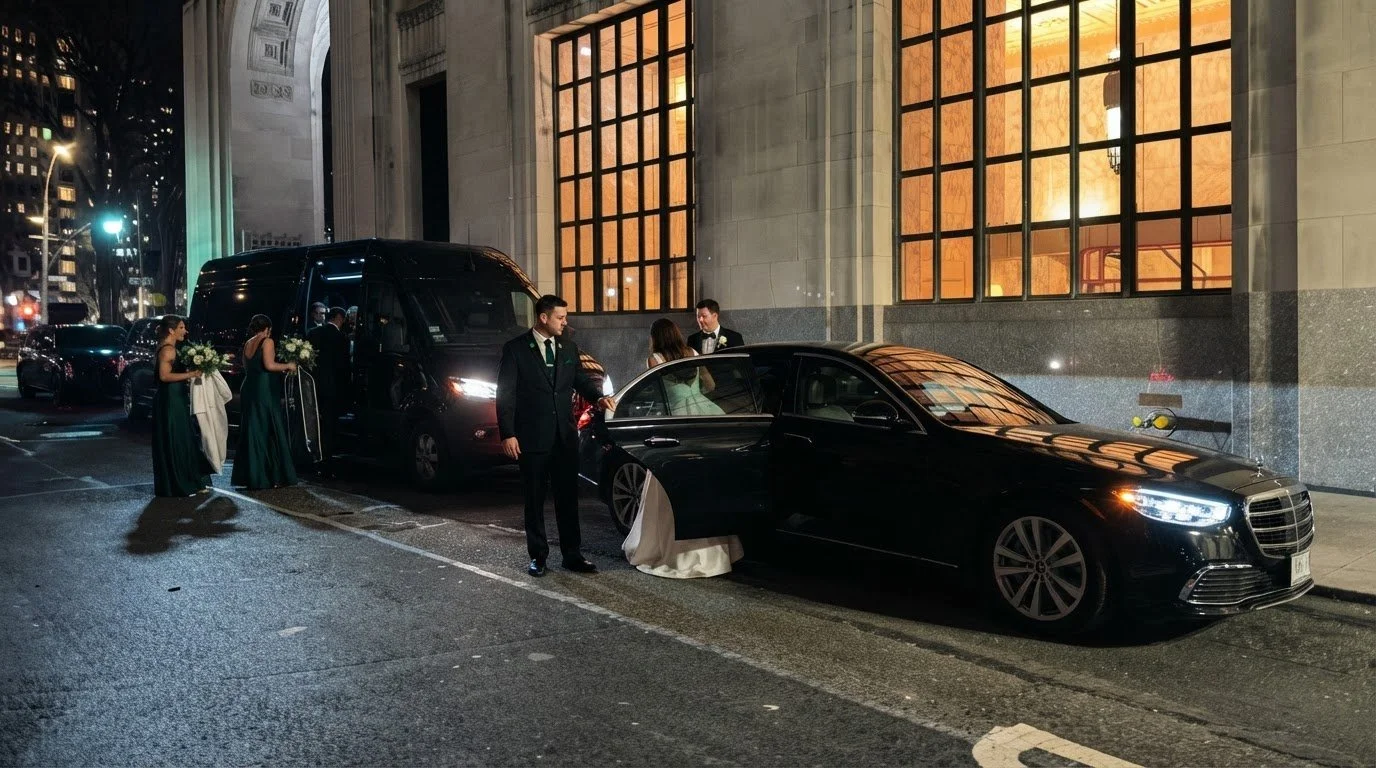
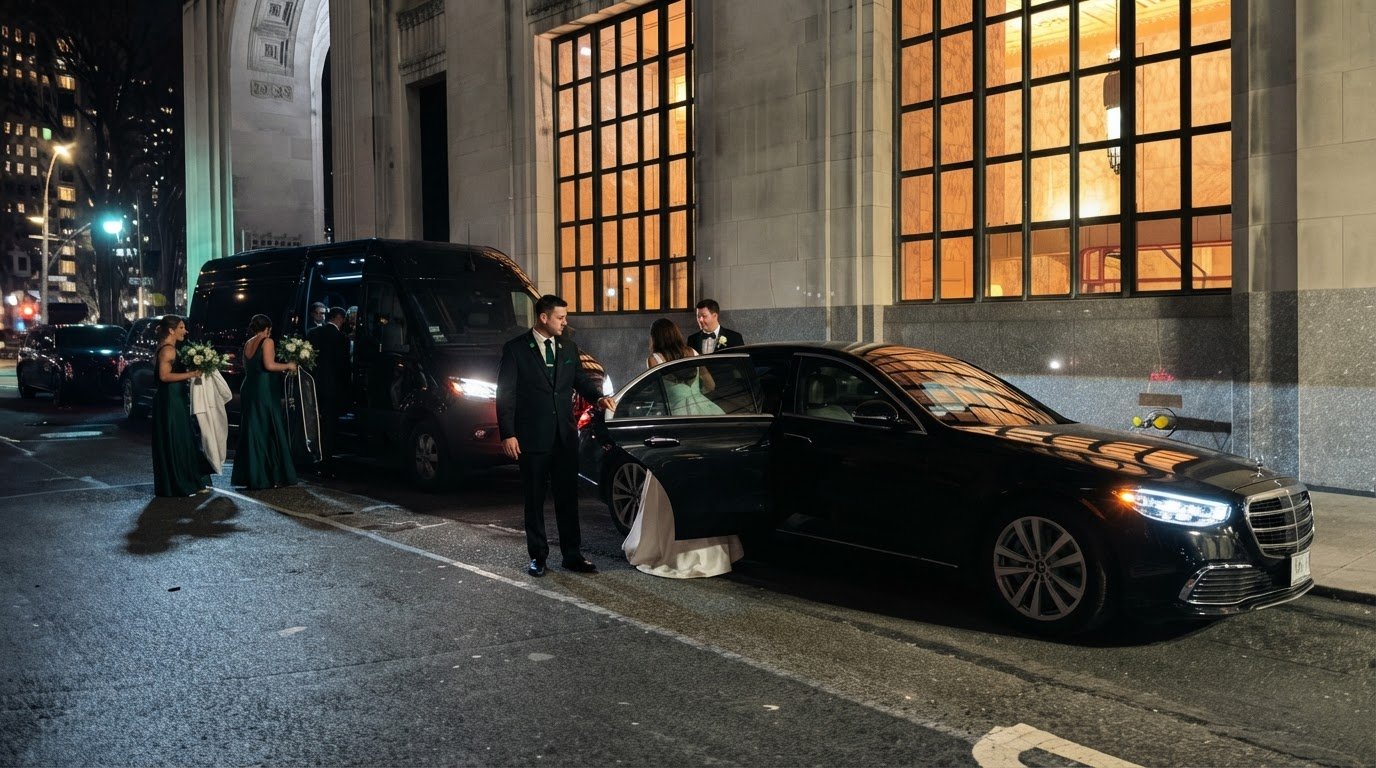
The couple and wedding party should be the first groups considered when coordinating transportation for a wedding party, with guest rides added when the day’s schedule or venue locations call for them. If the ceremony and reception are more than 30 minutes apart, couples should consider arranging transportation for all guests as well. A clear plan keeps arrivals, photos, and the move between venues in step.
It’s easy to focus on getting everyone to the ceremony and overlook the separate schedules that follow. This guide explains who may need a ride, when to plan each trip, which vehicles suit different groups, and how to coordinate departures between ceremony and reception venues. Distance, accessibility, and guests’ different arrival or departure times all shape a transportation plan that runs smoothly from the first pickup to the final ride.
Key Takeaways
- Prioritize rides for the couple and wedding party, then consider guest transportation when venue distance, access, or individual needs make it useful.
- Choose vehicles around each group’s size and pickup and drop-off access, not appearance alone.
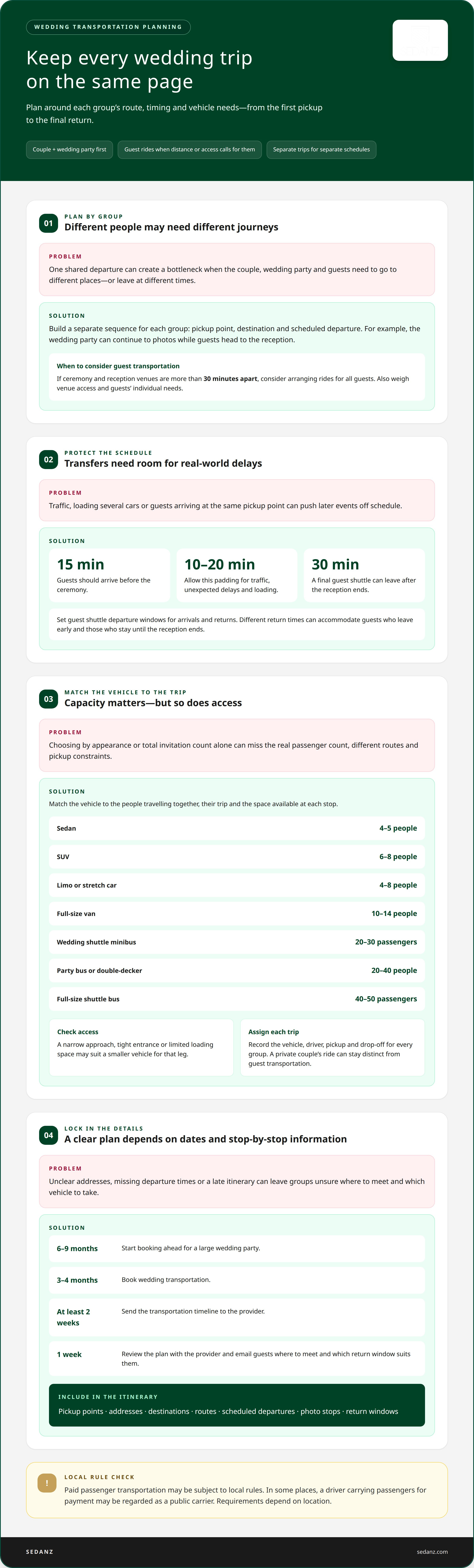
- Build travel time and a 15-minute buffer into the schedule so traffic or loading delays are less likely to disrupt later events.
- Plan separate departures when the wedding party, guests, and couple have different schedules after the ceremony.
- Share a clear itinerary with each stop’s address and timing to keep transfers between ceremony, photos, and reception organized.
Who Needs Wedding Transportation?
Prioritize rides for the couple and wedding party, then assess guest needs by venue, schedule, and access. Build a timeline that separates pickups, arrivals, photo stops, and return trips.
A professional transportation provider matches each group’s pickup location and destination to the event schedule. The couple, wedding party, and guests may need different departure times, especially after the ceremony. For example, the wedding party could continue to photos while guests travel to the reception. Separate schedules help each group reach the right place without crowding the same departure window.
How a Provider Plans Pickups, Destinations, and Schedules
Coordinating transportation for a wedding party means arranging the route and timing for each group’s journey. Create an itinerary with pickup points, destinations, and scheduled departures for hotels, the ceremony venue, photo locations, and the reception. A detailed sequence keeps transfers aligned, even when the couple and guests follow different routes.
How a Provider Schedules Guest Shuttles and Return Windows
A guest shuttle schedule sets departure windows for arrivals and returns, rather than treating every guest as one group. Guests may leave early or stay until the reception ends, so return trips at different times accommodate both. A final shuttle can depart 30 minutes after the reception ends. Separating those windows gives guests a defined ride while the wedding party follows its own schedule.
Arrival timing also needs room for loading. Guests should arrive 15 minutes before the ceremony, and the schedule should allow 10 to 20 minutes of padding for traffic, unexpected delays, and loading people into multiple cars. That allowance matters when several groups share a pickup point. A provider can place the buffer between pickup and arrival, protecting the ceremony timeline from a slow boarding process.
Paid passenger transportation can be subject to local rules. In some places, a driver carrying passengers for payment may be regarded as a public carrier. Requirements depend on the location, so transportation plans should account for the rules that apply where each wedding vehicle operates.
Book wedding transportation 3 to 4 months before the wedding; large wedding parties are advised to start booking 6 to 9 months ahead. Once scheduled, the provider can build the pickup and drop-off sequence around the event itinerary. The transportation timeline should reach the provider at least two weeks before the wedding, with a final review one week before.
Align pickup times, addresses, routes, and destinations for each group. Send guests the transportation details by email one week before the wedding, including where to meet and which return window suits them. When the ceremony and reception are at separate venues, clear stop-by-stop instructions help prevent confusion during the transition.
What Vehicles Suit the Wedding Party?
The right vehicle balances passenger capacity, pickup access, and the formality of the occasion. Use the guest count and itinerary to match each group with a suitable vehicle.
Matching Vehicle Capacity to Group Size with a Provider
A provider matches vehicle capacity to each group’s passenger count and trip requirements. A sedan typically suits 4-5 people, while an SUV holds 6-8. A full-size van can carry 10-14 people; a party bus or double-decker may suit groups of 20-40. These ranges help determine whether one vehicle can serve a group or whether several departures are needed.
Vehicle categories can overlap: a wedding shuttle minibus is listed for 20-30 passengers, while a full-size shuttle bus holds 40-50. A limo or stretch car typically carries 4-8 people. The provider considers how many passengers need each ride, then assigns vehicles to the couple, wedding party, or guests without planning from the invitation’s total guest count alone.
Capacity is only one part of the decision. Consider who is travelling together and whether groups have different pickup times or destinations. For example, the couple may need a private ride while the wedding party travels together. Matching each trip to its passengers makes the schedule clearer and avoids reserving more space than needed.
Assessing Vehicle Access and Style with a Provider
Weigh vehicle size against access at each pickup and drop-off point, then consider the wedding’s style. A large vehicle may suit a substantial guest group, but a tight entrance or limited loading space can affect where it can stop. Share venue addresses and pickup details to guide a practical vehicle choice.
The route matters, too. Consider access at each stop and the distance between the vehicle and the entrance when planning arrivals. If a location has a narrow approach, a smaller vehicle may work better for that leg. These details help ensure the arrival plan doesn’t depend on a vehicle that cannot reach the pickup point.
Wedding style can guide the final selection, but it shouldn’t replace a capacity and access assessment. A stretch car may suit a small wedding party, while a van can carry a larger group. Different vehicles can serve separate groups, keeping the couple’s arrival distinct from guest transportation.
A clear plan identifies the vehicle and assigned driver for each trip, along with a contingency for disruptions. Record every pickup and drop-off point so everyone knows where each vehicle is expected. This level of detail helps turn the plans into well-coordinated movements on the day.
Transportation for the couple, wedding party, and guests
Guest transportation matters most when venue access, distance, or individual needs make independent travel difficult. Arrange separate rides for the couple, wedding party, and guests when their schedules or routes differ.
Choosing When Guests Need Transportation
Guest rides are especially useful when a venue is remote, difficult to reach, or more than 30 minutes from the reception site. That distance can make independent travel less practical, particularly when guests must move between locations. A provider can arrange separate group transportation so guests aren’t left to organize unfamiliar routes themselves.
Consider transportation beyond the wedding day, too. Out-of-town guests may need airport pickups, while rehearsal dinners and next-day brunches add trips to the schedule. Plan each as a distinct journey, matching its pickup and destination to the event timetable.
Planning Guest Shuttles and Hotel Pickups with a Provider
A provider organizes guest shuttles around selected pickup points, venue access, and arrival times. If guests are staying at one or two main hotels, those locations can serve as shared pickup points instead of requiring separate stops at individual addresses. A shuttle may be useful when a hotel is 15 or more minutes from the venue.
For larger groups, the provider can schedule shuttles every 15 to 20 minutes until all guests reach the venue. The first guest shuttle can leave 15 minutes after the ceremony ends, giving guests time to exit before boarding. This approach also helps manage parking constraints at the destination.
Arranging Late-Night Transport and Guest Safety with a Provider
Plan return rides around guests’ different departure times, including a final shuttle after the reception. Separate windows give early departures and guests staying later an organized option, rather than expecting everyone to leave together. Clearly identify each return pickup point and destination.
For a smoother late-night departure, the provider can include loading time and planned stops in the itinerary. Guests need to know where to meet their ride and which departure suits them. Clear timing reduces confusion at a busy venue exit and helps the transportation plan account for traffic.
Accessibility belongs in the guest plan, too. Account for guests who face long walks from parking areas or across a spread-out venue. Identify pickup and drop-off points near relevant entrances, and share individual access needs with the transportation provider. A specific arrival plan means guests don’t have to manage difficult distances alone.
A wedding with a remote ceremony site and a separate reception may need different arrangements for guests and the wedding party. Guests could travel directly to the reception while the wedding party continues to photo locations. Coordinate these distinct journeys with a separate pickup time, destination, and return plan for each group.
Before the event, give guests their pickup location, departure window, and destination. Emailing these details one week before the wedding gives them time to understand the schedule. Align the information with the itinerary so guests know where to meet instead of having to work out parking or traffic themselves.
Coordinating transportation between separate ceremony and reception venues
Separate venues add a movement between ceremony, photos, and reception. A provider coordinates that route around each group’s timing and destination.
How a Provider Coordinates Ceremony, Photo, and Reception Travel
A provider connects the ceremony, photo locations, and reception in one timed itinerary. This matters because the wedding party may travel separately from guests after the ceremony. Wedding photos can add 30 to 90 minutes to the timeline. Listing each stop clearly helps the driver follow the planned sequence and keeps the reception arrival aligned with the event schedule.
The itinerary should give the times and addresses for hotels, the ceremony venue, photo locations, and reception site. For example, if the ceremony ends at 4:00 p.m. and the wedding party leaves for photos at 4:15 p.m., the provider can plan that departure as a distinct trip. A separate guest route can take guests directly toward the reception.
Planning Pre-Ceremony Timing and Logistics with a Provider
Pre-ceremony planning works backward from the ceremony start time to set pickup and arrival times. Guests should arrive 15 minutes early, while the provider also allows 10 to 20 minutes of padding for traffic, delays, and loading. This creates a defined arrival window rather than relying on the scheduled drive alone.
Distance alone doesn’t always predict travel time. A route that normally takes 25 minutes still needs room for traffic and boarding. In New Orleans, a five-mile drive might take 12 minutes or 35 minutes. Sharing the exact addresses and intended arrival time lets the provider plan around the route, not simply the mileage.
Managing Post-Ceremony Transportation with a Provider
Plan separate post-ceremony departures for guests, the wedding party, and the couple. This matters when the wedding party continues to photos while guests head to the reception. Schedule guest transportation around the day’s itinerary, with departures before the ceremony, during cocktail hour, and after the reception as needed.
For example, guests can travel onward after the ceremony while the wedding party boards for photos at a separate location. The provider records the photo stop and reception address, then schedules the next journey around the estimated photography window. Because photos may add 30 to 90 minutes, identifying that interval helps the reception team anticipate the wedding party’s arrival.
Each vehicle’s schedule should identify the departure point, destination, and pickup time. If the ceremony ends at 4:00 p.m., guests and the wedding party may need different movement plans rather than one shared departure. Clear assignments let the driver follow the route and help each group reach the correct venue without confusing the reception transfer with the photo journey.
Transportation for the couple and wedding party
The couple and wedding party often need a plan distinct from guest transportation. Work backward from the ceremony, allowing time for preparation, photos, and separate trips.
Start with each person’s first destination and required arrival time. Bridesmaids are recommended to arrive 90 minutes before the ceremony, the bride 45 minutes before, and the groom 30-45 minutes before. These separate arrival windows help the transportation provider assign pickups around hair and makeup appointments, rather than treating the wedding party as one group.
Next, the provider maps each leg: preparation location to ceremony, ceremony to photo location, and photos to reception. Allowing 30-45 minutes for each major wedding-day transportation segment creates a defined window for the drive and transition. The actual route, traffic, and number of stops influence how the schedule fits together.
A private ride can keep the couple’s movements separate from the wedding party’s. This is useful when the couple has a different departure time or wants to travel directly between locations. A larger party may need a vehicle suited to its group size. Coordinate both itineraries without forcing them into one pickup sequence.
Allow time for preparation and photography on the timeline. A hair-and-makeup appointment that runs late can delay a scheduled departure, while photos between the ceremony and reception can extend the time before the next trip. Include these activities in the itinerary so driving time isn’t mistaken for the full time each movement requires.
Keeping separate schedules for the couple and wedding party can reduce confusion. Each should identify who is riding, the pickup point, destination, departure time, and any photo stop. Record which group travels first, too, so a change in the couple’s plans doesn’t leave the wedding party without a clear next step.
For a larger wedding party, begin transportation planning well ahead. Groups of that size are advised to start booking six to nine months before the wedding. Then create a written itinerary with vehicles, times, addresses, routes, and special instructions. This gives the provider a clear basis for coordinating the day and adjusting the sequence when plans change.
For a carefully timed couple and wedding-party itinerary, plan your wedding-day transportation around each group’s schedule and destinations.
Sedanz: Special Event Transportation
Sedanz provides Special Event Transportation for wedding-day journeys, including separate rides for the couple, wedding party, or guests. Point-to-Point Transfers suit planned trips between specific locations, while Hourly Charters can support a schedule with several stops, such as the ceremony, photo location, and reception. Airport Transfers can also coordinate arrivals for out-of-town guests. Share the itinerary, pickup locations, destinations, and group arrangements when planning. These details help shape transportation around the day’s movements, rather than treating every trip as a single transfer. For a wedding schedule with distinct routes or several planned stops, Sedanz can be a natural transportation partner. Contact Sedanz to discuss transportation for your wedding day.
Make Room for the Moments That Matter
A considered transportation plan does more than connect locations. It gives the couple and wedding party fewer moving parts to manage, leaving more attention for the people and moments that make the day personal. As you move from planning to booking, focus on the experience you want each group to have, from the first pickup to the final departure.
Coordinating transportation for a wedding party is easier when routes, timing, and responsibilities are treated as one connected plan. Decide which movements matter most, then share those priorities with the transportation team. A well-planned itinerary supports the rhythm of the day without asking the couple to oversee every transfer.
When you’re ready to give your wedding-day travel a clear direction, plan your wedding transportation with Sedanz. Thoughtful coordination can help you arrive at the celebration feeling present, prepared, and ready to enjoy it.
Frequently Asked Questions
How Can a Transportation Provider Arrange Guest Shuttles?
Group guests by pickup point and destination, then schedule vehicles around the event itinerary. For example, guests staying at the same hotel can share a pickup location while the wedding party follows a separate plan. Account for guests who need easier access to the venue entrance. Clear departure windows and meeting-point instructions help guests board the right vehicle without disrupting the schedule.
How Does a Transportation Provider Plan Transportation Timing?
Plan timing backward from each group’s required arrival, allowing for the route and planned stops. The itinerary should distinguish driving time from boarding and unloading, since both affect when passengers reach the next location. A photo stop, for instance, changes the wedding party’s schedule but may not affect guests going directly to the reception. Keeping those movements separate makes changes easier to manage.
How Much Should You Budget for Transportation?
Wedding transportation costs depend on the vehicle, service duration, route, number of stops, and how many groups need separate trips. A single transfer has different planning needs from transportation involving several event locations. For Sedanz services, pricing depends on the specific transportation requirements and is provided after a quote request. Share the itinerary and passenger arrangements so the quote can reflect the planned journeys.
What wedding transportation options are available for guests and the wedding party?
Options include a private sedan or SUV for the couple, a van for a group, and scheduled transportation between event locations. Sedanz offers Luxury Sedan Service, Luxury SUV Service, and Mercedes Sprinter Van Service, alongside Special Event Transportation, Hourly Charters, and Point-to-Point Transfers. Airport Transfers can suit guests arriving from out of town. The right combination depends on each group’s route, schedule, and preferred level of privacy.
How many passengers fit in a wedding shuttle, limo, or party bus?
Typical capacities vary by vehicle: a limo holds 4-8 people, a wedding shuttle minibus 20-30 passengers, and a full-size shuttle bus 40-50 passengers. A party bus may hold 20-50 people. Sedanz’s large-capacity vehicles accommodate 10 to 49 passengers. Treat these as planning ranges, then match the actual vehicle to the passenger group and the locations it must reach.
How much does wedding transportation cost in the United States?
There isn’t one standard cost for wedding transportation across the United States. The amount depends on the vehicle, how long it is needed, the route, pickup locations, and whether the plan includes multiple stops or separate groups. Sedanz provides a quote based on the specific trip. A complete itinerary gives the quote a clear basis.
What Wedding Transportation Schedule Can a Provider Create for the Ceremony, Photos, and Reception?
Create a schedule that moves the couple and wedding party from preparation to the ceremony, then onward to photos and the reception. Guests may take a direct route to the reception while the wedding party pauses for photography. Show each group’s pickup, destination, and departure window in the itinerary. This helps the planner coordinate arrivals with venue staff and photographers.
How Does a Provider Coordinate Pickup Locations and Routes for Wedding Guests?
Coordinate guest routes around practical pickup points, venue addresses, and the order of stops. A hotel entrance, for example, can be a clearer meeting point than a broad property address. Account for guests who face access barriers or long walks from parking areas. Share precise location details so guests can find the right vehicle and departure point.