


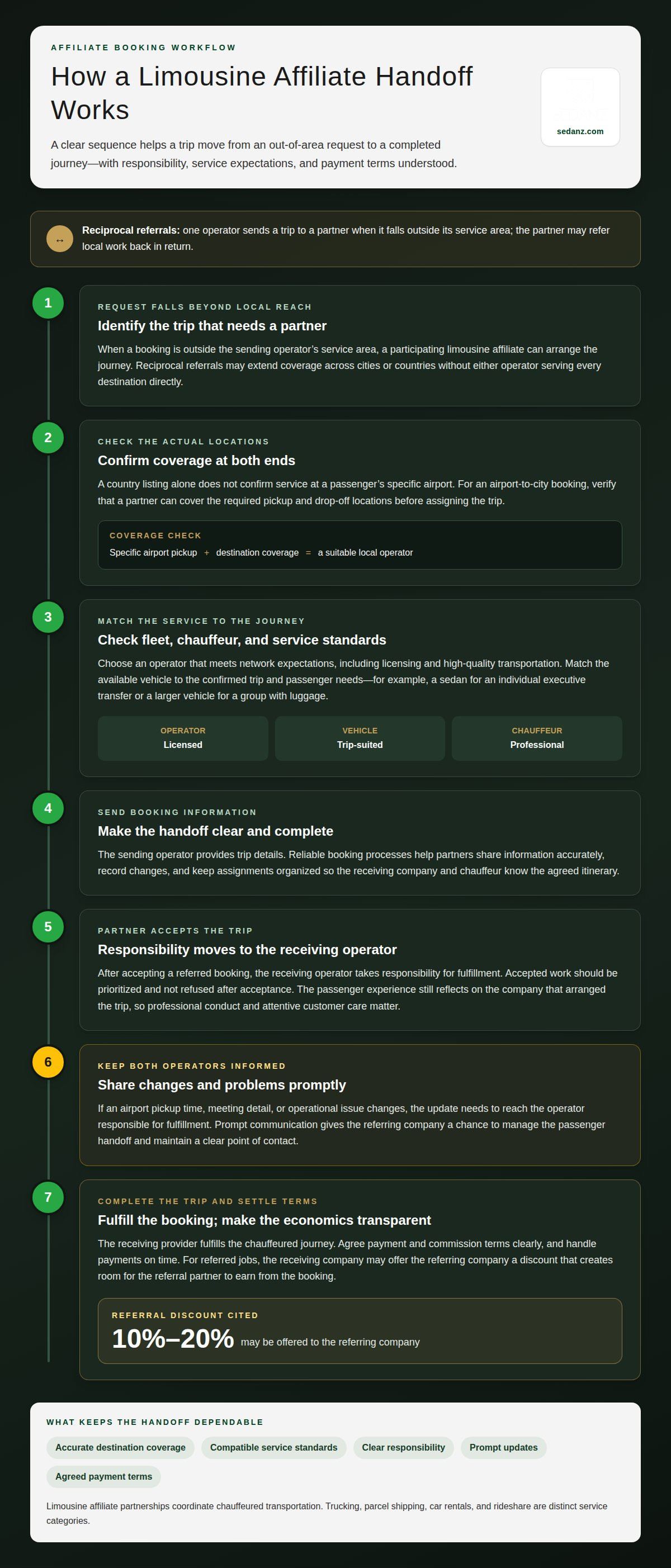
A local booking needn’t end at a company’s service-area boundary. Affiliate transportation companies arrange reciprocal referrals: one provider sends an out-of-area trip to a partner, and that partner can refer work back when a booking falls beyond its own reach. For referred jobs, the receiving company may offer the referring company a 10% to 20% discount, creating room for the referral partner to earn from the booking.
That arrangement can simplify journeys across cities or countries, but a successful handoff takes more than geographic coverage. Clear communication, compatible service standards, and agreed payment terms help keep the passenger experience consistent, from booking through drop-off.
This article explains how limousine affiliate partnerships handle referrals, out-of-area bookings, service expectations, and commissions. You’ll learn what happens when a trip goes to a partner, how providers coordinate responsibility, and which terms shape the business relationship.
Key Takeaways
- Affiliate arrangements let transportation providers coordinate trips beyond their own service areas while keeping booking responsibility clear.
- Consistent service depends on partner standards for vehicles, chauffeurs, customer care, and booking communication.
- Clear handoff procedures and prompt updates help keep a referred trip on track when plans change.
- Transparent commission terms and timely payments make the financial side of a partnership easier to manage.
- Global affiliate bookings can help coordinate airport transfers, hourly charters, and special-event travel across multiple destinations.
Reciprocal referrals and bookings outside a provider's service area
A reciprocal referral lets one limousine operator arrange a trip through a partner when a booking falls outside its service area. The partner may refer local work in return, extending both operators’ coverage without requiring either to serve every destination directly.
Country and Airport Coverage
Country and airport coverage shows which destinations participating operators serve, including specific airport pickups and drop-offs. A country-level listing alone doesn’t establish whether an operator covers a passenger’s actual airport. For example, an airport-to-city booking depends on partner coverage at both ends. Clear location details help the referring company assign the trip to an operator equipped to fulfill it.
Global Ground Transportation Services
Global ground transportation services connect local operators through referrals across countries and service areas. A passenger may book an airport transfer in one city and need another journey elsewhere; an affiliate network coordinates those trips through participating providers. The arrangement covers chauffeured transportation, not every travel-related service. Trucking, parcel shipping, car rentals, and rideshare are distinct categories, even when their companies run affiliate or partner programs.
Service Priorities and Reliability
Service priorities are the operating expectations a receiving affiliate follows after accepting a referred trip. The receiving operator should prioritize farmed-in work, avoid refusing a job after acceptance, and promptly alert the referring company if a problem arises. For example, an operational issue affecting an airport pickup calls for a timely update between operators. That communication gives the referring company a chance to manage the passenger handoff instead of leaving the booking without a clear point of contact.
Which transportation affiliate networks list multiple U.S. programs? For limousine bookings, look for networks that connect operators across U.S. service areas. Compare their participating coverage and booking processes, not just the number of programs they list.
What rules and disclosures apply to transportation affiliate marketing in the United States? A trip referral between operators is a business-to-business booking arrangement; public promotional content is a separate activity. If a promotion may generate compensation, disclose that relationship clearly near the endorsement so readers understand its commercial context.
Which transportation companies offer affiliate or partner programs in the United States? In limousine transportation, participating providers accept referrals for trips beyond another operator’s coverage and may refer local bookings in return. Their role is to fulfill the referred journey, not simply advertise a service.
What services can affiliates promote, such as trucking, shipping, car rentals, or rideshare? Affiliate programs can cover various transportation categories, including trucking, shipping, car rentals, and rideshare. Limousine affiliate partnerships coordinate chauffeured bookings, so the service category determines what the referral covers.
For each referred booking, the sending operator provides trip details, and the receiving operator takes responsibility for fulfillment after accepting it. Reciprocal referrals can extend geographic reach, but dependable coverage relies on accurate destination information, clear communication, and follow-through on the accepted booking.
Fleet and chauffeur quality expectations
Fleet and chauffeur standards determine whether an affiliate can deliver the service promised at booking. Limousine networks typically expect participating providers to be licensed and deliver high-quality transportation. These expectations matter because the referring operator’s reputation travels with the booking, even when another company supplies the vehicle and chauffeur.
Fleet quality is about more than appearance. Choose a vehicle suited to the confirmed trip, passenger needs, and booked service. A sedan may suit an individual executive transfer, while a larger vehicle may better accommodate a group with luggage. A network with varied fleet options can meet different requirements across its partners. That variety helps the referring operator match each booking with a suitable local provider instead of treating every journey alike.
Chauffeur professionalism matters just as much. The driver represents both the receiving operator and, in the passenger’s eyes, the company that arranged the trip. Professional conduct, clear communication, and attentive customer service help maintain continuity during the handoff. For example, a chauffeur handling a business pickup should know the agreed itinerary and communicate courteously with the passenger. Strong customer service is a network expectation, not an optional extra.
Reliable booking processes support both the people and the vehicles involved. A dependable system helps partners share trip information accurately, record changes, and keep assignments organized. If an airport pickup time or meeting details change, the update must reach the operator responsible for fulfillment. Clear records reduce confusion among the referring company, receiving company, and chauffeur. Visible responsibilities help prevent missed details from becoming passenger-facing problems.
Together, these standards offer a practical way to assess a partner’s readiness:
- Licensing and service quality: The operator meets the network’s expectations for professional limousine transportation.
- Fleet suitability: Available vehicle types align with the booked journey and passenger requirements.
- Chauffeur conduct: Drivers deliver professional service and communicate clearly during the trip.
- Booking coordination: The system supports accurate trip details and dependable communication between partners.
A single strength cannot compensate for a weak handoff. A polished vehicle still depends on an informed chauffeur, while a professional driver needs accurate booking details. For an operator coordinating a chauffeured transportation service, these connected standards help make an affiliate booking feel coherent from assignment through drop-off.
How limousine affiliate partnerships operate
A limousine affiliate partnership turns a referral into an agreed booking between transportation operators. One company manages the client relationship while a partner fulfills the trip. For affiliate transportation companies, clear responsibilities help each party understand what it has accepted and what it must deliver.
Joining a network commonly starts with an application. The network reviews the applicant’s operation, fleet, and services to assess suitability. This helps match a provider’s capabilities with the work it may receive. Fleet options and operating practices can determine which bookings fit an operator’s services.
Once a partnership begins, the referring operator shares trip details with the affiliate selected to perform the journey. The receiving company accepts the assignment, organizes the service, and communicates relevant changes. A trip request, for example, should specify the pickup, destination, timing, and passenger requirements. Complete details give the affiliate a clear basis for planning.
Payment arrangements need to be defined, too. Companies can agree on how referrals are compensated, which records support payment, and when settlement is due. A credit card authorization form can document payment permission between companies. The operator farming out the work should pay its affiliate promptly for services rendered, and the receiving company should clarify any referral discount before accepting the job.
What risks should affiliates consider, including cancellations, chargebacks, and liability? Cancellations may leave a provider with resources reserved for a trip, while chargebacks can challenge a payment. Written terms should explain cancellation handling, payment records, and how partners address service complaints or losses. These provisions clarify responsibilities before a dispute arises.
A defined sequence helps affiliate transportation companies manage each booking:
- Apply: The network reviews the provider’s operation, fleet, and services.
- Agree: Both companies document payment, referral, and cancellation terms.
- Assign: The referring operator shares complete trip information.
- Fulfill: The receiving affiliate performs the accepted journey and reports problems promptly.
- Settle: The companies reconcile the completed trip under their agreement.
For coordinated chauffeured transportation, a well-defined booking handoff connects the passenger’s itinerary with clear operating and payment responsibilities. Each company can then manage its part of the arrangement with greater clarity.
Revenue opportunities and commissions
A limousine referral can generate revenue for the company that introduces a booking. The receiving operator fulfills the trip, then shares value with the referring company under their agreed terms. Clear terms make the relationship easier to manage and show how each completed job contributes to revenue.
For farmed-in limousine work, receiving companies are advised to offer a discount of 10% to 20%, allowing the referring company to earn money. The discount is a commercial arrangement between the companies, not a passenger fare recommendation. Both parties should establish how it applies before accepting the booking. They can specify whether it is calculated against the agreed trip amount and how completed work is documented.
Transparent payment terms should specify the commission rate, what earns commission, and when payment is due. For example, companies can decide whether payment follows trip completion or receipt of the relevant invoice. The operator farming out work should pay its affiliate promptly for services rendered. Timely settlement helps partners track earnings and align payments with the service already delivered.
How do transportation affiliate programs compare by commission, cookie duration, and payment threshold? Limousine referral arrangements focus on agreed compensation for a fulfilled booking. Cookie duration and payment thresholds are digital affiliate-program terms. They apply when a program tracks online referrals and should be compared in its written conditions.
These measures describe different parts of a transaction. A commission rate specifies the share or discount earned from a qualifying referral. Cookie duration defines how long an online referral can receive credit after a user clicks a tracking link. A payment threshold sets the balance required before a program sends earnings. For chauffeured bookings, the trip record and partner agreement establish the referral and payment basis.
Some networks may offer bonuses for strong performance or a higher volume of referred business. These incentives can reward ongoing participation, but written terms should explain the qualifying activity and bonus calculation. Clearly define any condition, such as a referral count or completed trip, to avoid differing interpretations.
Before work begins, partners can agree on these financial details:
- Commission basis: Identify the booking or completed service that qualifies.
- Calculation: State how the agreed discount or commission applies.
- Payment timing: Set when the receiving affiliate should be paid.
- Incentives: Describe any bonus conditions and the performance they recognize.
Recording these terms makes referrals easier to reconcile after a journey. Companies can match booking records to agreed compensation, resolve discrepancies using specific details, and see how repeat referrals support a sustainable partnership.
A limousine referral earns the compensation partners agree on for a fulfilled booking. In online programs, cookie duration is the period a click can receive referral credit, while a payment threshold is the balance needed before payout. Each program’s written conditions specify its cookie duration and payment threshold.
What does an affiliate transportation company do?
An affiliate transportation company coordinates or fulfills a ride referred by another operator. In limousine work, one provider manages the booking relationship while a partner performs a journey beyond its service area. The affiliate’s role is practical: receive trip details, accept responsibility, arrange transportation, and communicate changes to the referring company.
The two companies may serve different roles in the same reservation. The referring operator remains the passenger’s initial point of contact, while the receiving operator manages local fulfillment. A passenger, for example, may book a point-to-point journey in one city through a company based elsewhere. Its affiliate supplies the local vehicle and chauffeur, then shares updates that affect the booking.
An affiliate relationship connects transportation businesses; it is more than a directory listing. A provider accepting work needs an operation, fleet, and services that meet the network’s expectations. Professional chauffeurs, customer service, and a reliable booking system support the work. Together, these elements help the receiving company turn a referral into a well-managed trip.
In practice, the affiliate’s responsibilities can include:
- Reviewing the assignment: Understand pickup, destination, timing, and passenger requirements.
- Accepting the trip: Take responsibility for the referred job before treating it as confirmed.
- Managing fulfillment: Arrange the agreed transportation with an appropriate vehicle and chauffeur.
- Communicating changes: Notify the referring operator promptly if a problem affects the booking.
- Settling the account: Follow the companies’ payment terms for services rendered.
That role differs from a company that only promotes an online link. A digital affiliate may earn credit when a tracked referral leads to a sale, subject to terms such as cookie duration and payment thresholds. A limousine affiliate coordinates an actual transportation booking between operators. The accepted trip and the agreement governing its fulfillment and compensation form the relevant record.
For passengers, the value is a connected booking across operators. For the referring company, the arrangement extends its ability to coordinate journeys beyond its operating area. For the affiliate, it brings work from incoming referrals, along with clear duties for service delivery, communication, and payment.
For an out-of-area chauffeured journey, coordinate transportation through a global affiliate network to connect the booking with local fulfillment and a defined operating handoff.
Sedanz: Global Affiliate Bookings
Sedanz provides Global Affiliate Bookings for travelers who need chauffeured transportation coordinated across destinations. This can suit a journey that extends beyond one local operator’s coverage or involves separate ground transportation needs in different places.
A travel plan might combine an airport transfer with a later point-to-point journey, an hourly charter, or special event transportation. Sedanz’s global affiliate network helps coordinate these bookings through international partners, connecting travelers with local ground transportation.
Share your itinerary and the transportation you need, such as airport or event travel. Contact Sedanz to discuss coordinating your journey through Global Affiliate Bookings.
Build the Next Partnership with Confidence
For affiliate transportation companies, the next opportunity is to make partnership planning part of a consistent passenger experience. A well-matched referral should suit the journey, passenger needs, and service expectations attached to the booking. This approach helps turn one connection into a relationship partners can build on.
Sedanz combines partnership coordination with practical travel services, including Airport Transfers, Hourly Charters, and Point-to-Point Transfers. Whether your plans involve a local connection or ground transportation across destinations, contact Sedanz to discuss the next step.
Discuss partnerships with Sedanz and explore how coordinated bookings could support your transportation needs. A thoughtful partnership is a promising place to begin.
Frequently Asked Questions
How Does an Affiliate Partnership Work?
An affiliate partnership connects a transportation booking with a separate operator able to fulfill it. For example, a corporate travel coordinator may arrange ground transportation in a city where their usual provider doesn’t operate. The local affiliate handles the ride, while the original company maintains its relationship with the traveler. Before the trip, both operators should agree on passenger requirements, responsibility for updates, and how they will record the completed booking.
What is a Limousine Affiliate Program?
A limousine affiliate program is a business arrangement that lets transportation providers exchange or fulfill referred bookings. It can help an operator coordinate a journey beyond its coverage without maintaining vehicles in every destination. A useful program defines how bookings are assigned, what service expectations apply, and how participating companies communicate. Unlike an online referral scheme that tracks clicks, a limousine program centers on delivering a chauffeured trip.
Who Can Become a Limo Affiliate?
Established limousine and chauffeured transportation providers are natural participants, particularly those able to serve bookings for partner companies. Networks typically look for licensed operators offering high-quality transportation, professional chauffeurs, attentive customer service, and dependable booking systems. A provider’s vehicle options and operating capabilities help determine which referrals it can handle. For example, an operator suited to executive sedan trips may receive different assignments from one equipped for larger groups.
Why Join an Affiliate Network in Ground Transportation?
A ground transportation affiliate network can help a provider serve clients whose itineraries extend beyond its usual operating area. It can also bring incoming bookings when partner companies need local fulfillment. For a corporate coordinator, one relationship may simplify planning across destinations. The benefits depend on useful coverage, responsive communication, and trip types that match participating providers’ capabilities, not just the size of a network’s directory.
How do transportation affiliate programs work?
Programs generally connect a referring business with a transportation provider responsible for completing the ride. The referring party shares the itinerary and passenger needs; the receiving operator organizes the service and communicates relevant changes. For instance, an event planner arranging transportation in another city can use a partner for local fulfillment. The companies document their commercial terms separately from the passenger’s itinerary, keeping operations and settlement distinct.
What are the commission rates, referral fees, and payout terms?
Participating companies or the network set commission and payout terms, which should be clear before a booking is accepted. The agreement can define which completed trips qualify, how compensation is calculated, what records support payment, and when settlement occurs. Cookie duration and payment thresholds belong to digital tracking programs, not necessarily chauffeured-trip referrals. For ground transportation, written booking and payment records give both parties a clear basis for reconciliation.
What are the eligibility requirements to become a transportation affiliate?
Eligibility commonly depends on a provider’s ability to deliver professional transportation and coordinate reliably with referring businesses. Networks may assess licensing, fleet, operating practices, chauffeur professionalism, customer service, and booking systems. A provider’s capabilities should match the assignments it accepts. For example, a network assessing an operator for airport work would consider whether it can manage the trip details and passenger handoff.
How can I apply to a transportation affiliate program?
Applications typically start with information about the transportation company, its operation, fleet, and services. A network reviews those details to assess suitability before accepting the provider. Prepare a concise description of the journeys your company handles, the vehicles available, and how you manage bookings. Then follow the program’s application process and provide the requested business details. Once accepted, clarify referral, communication, and payment terms before fulfilling partner bookings.