


A packed itinerary isn’t always the biggest source of business travel stress. Long travel days, missed connections, shifting schedules, disrupted routines, and pressure to perform away from home can all take a toll. Reducing travel stress for executives starts with identifying these pressure points and planning practical support around them.
It’s natural to focus first on flights and meeting times. Yet a calmer trip often depends on the details around them: preparing for delays, keeping travel information close at hand, and maintaining habits that help you feel rested and focused.
This article explains what commonly makes business travel stressful and how to respond with realistic planning, healthy routines, mobile tools, and familiar comforts. Find practical ways to make travel days more manageable, protect time for rest, and arrive better prepared for work.
Key Takeaways
- Identify the parts of a trip most likely to create pressure, then build practical contingencies into the itinerary.
- Protect time for sleep, movement, and brief calming practices to support focus and steadier energy.
- Keep bookings, schedules, and travel updates easy to access on a mobile device so changes are simpler to manage.
- Pack a few familiar items and preserve small daily rituals to feel more grounded away from home.
- Use a planned airport transfer or point-to-point ride to make the ground-transport portion of a business trip more orderly.
1. What causes stress during business travel?
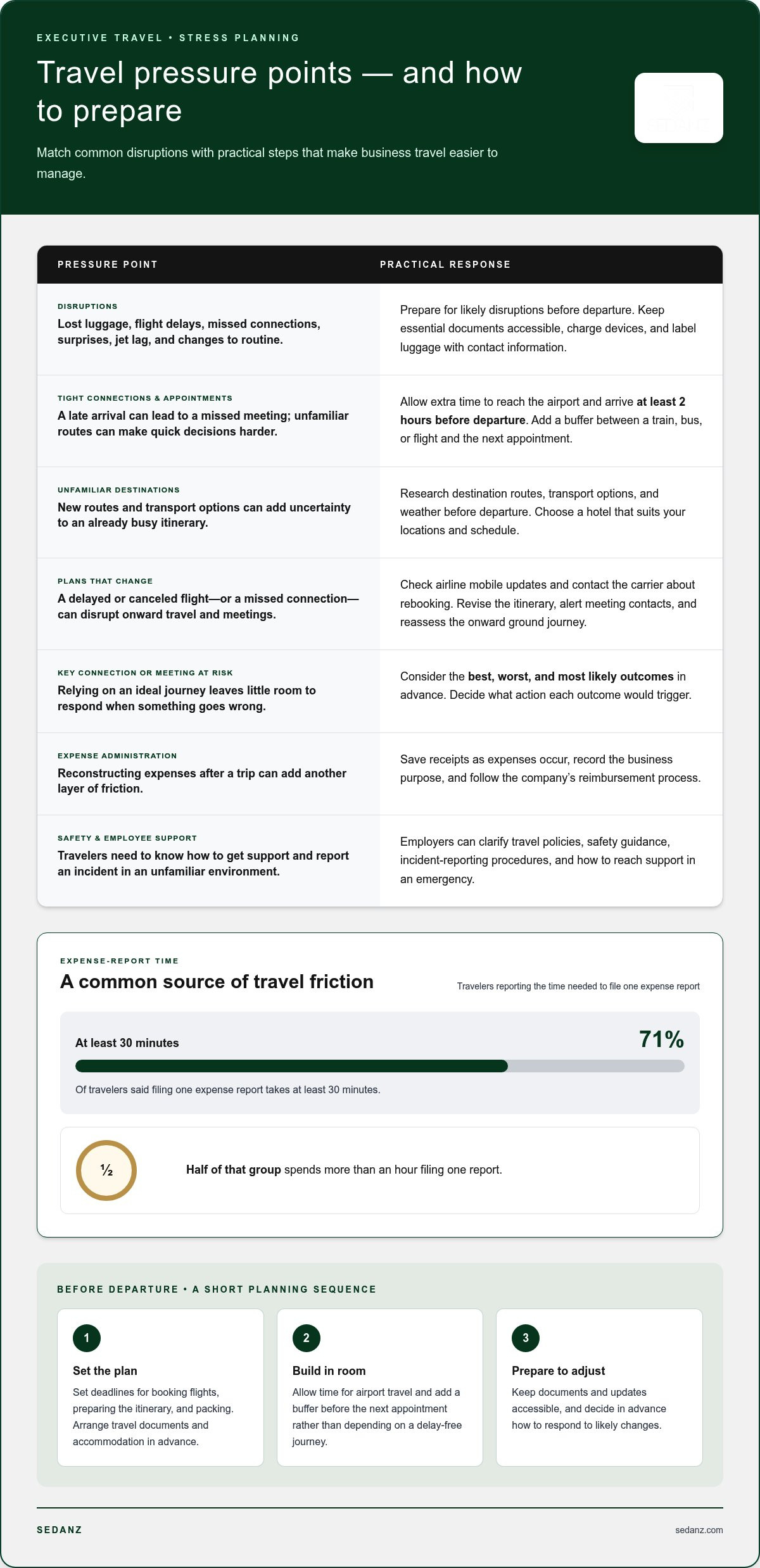
For U.S. executive travel, duty-of-care planning means clear travel policies, safety guidance for unfamiliar environments, and procedures for reporting incidents. Employers should also explain how travelers can reach support in an emergency, so employees know what to do before departure.
Stress often builds when several disruptions happen at once. Carlson Wagonlit Travel identified lost luggage, flight delays, missed connections, missed work time, surprises, jet lag, and changes to routine as common pressure points. A packed itinerary can turn a late arrival into a missed meeting, while unfamiliar routes make quick decisions harder.
Planning ahead gives you room to manage disruptions. Set deadlines for booking flights, preparing the itinerary, and packing; arrange travel documents and accommodation in advance. Choose a hotel that suits your locations and schedule, and research destination routes, transport options, and weather before departure.
Time buffers matter. If you’re concerned about missing a flight, allow extra time to reach the airport and arrive at least two hours before departure. Add a buffer between a train, bus, or flight and your next appointment instead of relying on an ideal journey with no delays.
Make a simple contingency plan before leaving. Consider the best, worst, and most likely outcomes for a key connection or meeting, then decide what action each would trigger. Pack early, charge devices, label luggage with contact information, and keep essential documents accessible. These steps reduce last-minute searching and help executives respond calmly.
Expense administration can add another layer of friction. In the 2026 State of Corporate Travel & Expense report by Skift and Navan, 71% of travelers said filing one expense report takes at least 30 minutes; half of that group spends more than an hour. Save receipts as expenses occur, record the business purpose, and follow the company’s reimbursement process to avoid reconstructing the trip later.
If a flight is delayed or canceled, or you miss a connection, check the airline’s mobile updates and contact the carrier about rebooking. Then revise the itinerary, alert meeting contacts, and reassess the onward ground journey. A point-to-point transfer can connect the updated arrival point with the next appointment.
The most effective stress-reduction steps are practical: plan ahead, allow extra time, keep documents and updates accessible, and prepare for likely disruptions. Companies can also review travel policies each year and clarify expectations for bookings, expenses, safety, and employee support.
2. Supporting healthy routines and stress management
A useful stress-management plan starts with the executive’s actual needs, not a generic wellness checklist. Before each trip, identify what supports your focus: adequate sleep, movement, quiet time, or contact with family. Then place those habits on the itinerary, alongside meetings and travel schedules. If you need at least 8 hours of sleep to feel your best, protect that time when arranging evening commitments and morning departures.
Build brief practices into the day instead of waiting for a long break. Set aside time for deep breathing, meditation, or journaling. A playlist, book, or simple breathing exercise can make airport downtime more restorative. Choose a method you already find comfortable and keep it accessible, so a delayed flight or demanding afternoon doesn’t interrupt the routine.
Movement helps counter the strain of sitting for extended periods. Add a 20-minute walk around the hotel to a free interval, or take a short walk after a meeting before returning to email. Physical activity can ease tense muscles and provide a clear transition between work and rest. If the day is tightly scheduled, set a realistic goal with your manager instead of treating exercise as another task to complete perfectly.
Workload planning matters as much as personal habits. Before departure, agree with your manager on essential priorities and identify work that can wait if travel demands increase. Avoid filling every available space with back-to-back meetings; leave room for meals, preparation, and recovery. A corporate travel program can support this approach by setting expectations for reasonable schedules, rest, and employee well-being.
Long-haul travel calls for deliberate recovery. After an overnight or transoceanic flight, avoid scheduling major meetings early the next day when possible. A buffer day before important commitments gives you time to rest and adjust to the destination. If your itinerary can’t allow that, protect an evening for sleep and keep the first morning’s agenda focused on essential work.
Staying connected can also help steady a demanding trip. For international travel, schedule calls with loved ones in advance, accounting for time-zone differences. Choose an evening time to put away your laptop, then follow a familiar wind-down habit, such as reading before bed. These boundaries separate business responsibilities from personal time and make recovery part of the schedule, not an afterthought.
Review the plan after each trip. Note which meeting patterns, sleep windows, and calming practices worked, then adjust the next itinerary. This reflection turns stress management into a practical routine that can evolve with changing destinations and workloads.
3. Mobile booking tools and travel information
A reliable mobile setup makes it easier to manage an itinerary when plans change. Before departure, save booking confirmations, ticket details, hotel information, meeting locations, and key contact numbers in one accessible place. Use a mobile-friendly booking tool or well-configured travel app, and make sure you can find essential details without searching a crowded inbox.
Book transportation tickets in advance when schedules matter, and avoid layovers when a practical nonstop option suits the trip. Every connection adds a timing decision and another chance for a delay to affect the next leg. Compare total journey time, departure and arrival points, and meeting commitments before choosing a ticket. A business-class seat may also be worth considering based on travel time and the need to arrive rested.
For airport wait times, check in online when the airline offers it, and consider fast-track or priority security lanes where available. Traveling earlier in the day or at off-peak times may help you avoid some disruptions. Before leaving for the airport, review the airline’s website and current weather reports for schedule changes or conditions that could affect your route.
Keep travel information useful, not overwhelming. Review the itinerary the evening before departure, then note your next action: where to go, when to leave, and which confirmation to show. For an international trip, include local transport routes, schedules, meeting addresses, and time-zone differences. This gives you a clear reference in unfamiliar surroundings, rather than relying on memory during airport downtime.
Mobile tools can reduce anxiety by making changes easier to assess. If a flight time shifts, compare the revised arrival with ground transport, hotel check-in, and your first meeting. Update the people affected and keep the latest itinerary easy to find. Give yourself time to review changes before moving between terminals or onward connections.
Executive travel management costs depend on the program’s scope, booking volume, support model, and itinerary complexity. Transportation pricing depends on the trip and is provided after a quote request.
Include the arrival and onward journey in the same itinerary. A prearranged airport or point-to-point transfer can connect the airport with a hotel or meeting location, reducing the need to make separate transport decisions after landing. Keep pickup details alongside flight information so the transition from air travel to your next commitment is clear.
Choose tools that suit the traveler and the company’s process. A concise itinerary, current airline information, and accessible booking records can streamline decisions without filling your phone with unnecessary apps. When disruption occurs, check the airline’s latest updates first, then revise the schedule and promptly notify meeting contacts.
4. Preserving familiar routines while traveling
A familiar routine can make an unfamiliar destination easier to manage. Keep the parts that travel well instead of trying to reproduce every detail of home. For example, an executive who usually starts the day with quiet reading can pack a paperback and set aside a calm moment before checking work messages. The habit stays familiar, even when the setting changes.
Choose self-care that fits the trip’s demands. A realistic routine might mean stretching after a long car ride, writing a few lines in a journal between appointments, or taking a short walk near the hotel. These simple actions require little equipment and can be adjusted when a meeting runs late or plans change.
Pack with the habits you want to maintain in mind. Workout gear can support a familiar exercise routine, while a book or journal offers an alternative to another screen during downtime. A personal pillow may also help preserve your preferred sleep environment. Keep these items easy to reach, not buried beneath presentation materials.
Research the destination before deciding which routines to bring. Look for practical amenities such as a gym, footpaths, or nature trails near the hotel. If outdoor exercise is part of your usual week, a nearby walking route may be more realistic than relying on unfamiliar equipment. Knowing the options in advance helps turn intention into a workable plan.
Keep routines flexible across frequent trips. A traveler who usually exercises outdoors could walk near the hotel on one trip and use workout gear indoors on another. The goal isn’t to match the home schedule exactly, but to preserve a familiar cue, such as moving after waking or reading before bed, in a way that suits the destination.
Small personal rituals can support mental health by adding continuity to days shaped by appointments and changing surroundings. Choose one or two restorative habits, then decide where they fit around the itinerary. For instance, pack a journal and write during a quiet interval, or set aside time to call someone familiar after work.
After returning, note which choices worked and which went unused. If a walking route near one hotel made it easy to stay active, look for similar options on the next trip. If an item never left the suitcase, replace it with something more useful. This brief review keeps future routines simple, personal, and suited to real travel conditions.
5. Identifying common causes of business travel stress
Business travel stress often builds from overlapping demands, not one isolated inconvenience. Long travel days, complex itineraries, unclear company policies, disrupted routines, and pressure to perform away from home can combine. An executive might land tired, face an unfamiliar route, and still be expected to lead a high-stakes meeting. Naming the sources helps separate fixable friction from unavoidable demands.
Look for patterns in how travel affects the employee’s day. A missed connection may create more strain when the itinerary leaves little room before a presentation. Expense administration can also extend the workday: in the 2026 State of Corporate Travel & Expense report by Skift and Navan, 71% of travelers said filing one expense report takes at least 30 minutes. Record recurring pressure points, such as late arrivals or time-consuming expense tasks, rather than describing the trip only as “difficult.”
Frequency is another useful signal. A travel-intensity framework treats 1-6 nights per month as a low-risk tier and 7-13 nights per month as a moderate-risk tier. It recommends intervention at 14-20 nights per month and immediate enhanced support at 21 or more nights per month. These thresholds can help managers notice when frequent travel calls for workload adjustments, recovery time, or a conversation about staying well on the road.
Use a brief post-trip review to identify what caused strain. Note the most demanding travel day, any schedule conflict, whether expectations were clear, and what affected concentration. Then choose one change for the next trip. If late meetings repeatedly disrupt rest, move a lower-priority task or revise the meeting plan. If unclear expense procedures create extra work, clarify the process before departure.
Executives and managers can also distinguish a single disruption from a recurring pattern. A weather delay may be outside anyone’s control; scheduling major work immediately after a long journey may be adjustable. Reviewing both together helps teams choose strategies that address the cause, rather than simply asking the traveler to tolerate more pressure.
After the return, share practical feedback with the person who manages travel planning. Identify which policy, itinerary choice, or workload decision contributed most, and propose a specific adjustment. A planned ground transportation arrangement can also help organize travel between appointments, reducing one source of logistical uncertainty.
Sedanz: Airport Transfers
Sedanz provides Airport Transfers for executives planning the ground-transport portion of a business itinerary. When a trip includes several appointments, Point-to-Point Transfers can connect planned stops, while Hourly Charters provide a dedicated option for travel over a scheduled period. A Luxury Sedan Service may suit an executive traveling between the airport, hotel, and meetings.
Including ground transportation in the itinerary helps reduce decisions after landing. It can be especially useful when plans involve multiple destinations or a tightly organized workday. Choose the service that fits the journey and include its details in the trip plan.
For help arranging executive ground transportation, contact Sedanz.
Make Your Next Trip More Intentional
Use your next business trip to make one deliberate change. Choose a routine that supports your focus, protect time for recovery, or simplify a demanding stretch of ground travel. Small adjustments can help you feel more prepared without redesigning your entire schedule. Over time, reducing travel stress for executives becomes less about controlling every disruption and more about creating a travel rhythm that supports both the work and the person doing it.
For ground transportation as part of your plan, Sedanz offers Airport Transfers, Hourly Charters, and Point-to-Point Transfers for executive travel. Choose the option that fits your itinerary, whether you’re traveling from the airport to a meeting or coordinating several planned stops.
Contact Sedanz to discuss travel support for an upcoming trip. A considered plan can make the journey feel more manageable, leaving you better positioned to focus on what matters at your destination.
Frequently Asked Questions
What causes stress during business travel?
Stress often comes from uncertainty, competing demands, and reduced control over the day. A flight delay may be manageable on its own, but harder when it disrupts a client presentation or leaves work unfinished. To identify the main cause, note what changed, what followed, and which part could be adjusted next time. This makes reducing travel stress for executives a practical review, not just a general goal.
How can companies support employee wellbeing during business travel?
Companies can include well-being in their travel policy, with clear expectations for trip planning, safety, expenses, and support. Give employees a named contact for travel problems and a clear process for reporting safety concerns. After a trip, invite specific feedback about scheduling or policy friction. Reviewing the policy each year helps keep guidance aligned with employee needs and changing travel patterns.
Why is traveler comfort important in corporate travel programs?
Comfort can help employees arrive with more energy for work, particularly after a long or complex journey. It also affects how well a traveler can focus between transport, preparation, and client commitments. Corporate travel programs can treat comfort as a planning consideration, not simply a preference: match the journey to the employee’s needs, allow room for recovery, and avoid scheduling essential work around the tightest points of a travel day.
What travel planning services and apps help reduce stress for business travelers?
Mobile booking tools and travel apps keep confirmations, itinerary updates, and contact details accessible in transit. Choose tools that show the current trip clearly and make changes easy to find. For ground travel, Sedanz offers Airport Transfers, Point-to-Point Transfers, and Global Affiliate Bookings. These services can help coordinate planned travel between airports, meetings, and destinations without requiring executives to arrange each ground leg separately.
What strategies help executives stay productive without overloading their travel schedule?
Separate essential outcomes from tasks that can wait, then build the schedule around the essential work. For a client visit, prioritize the presentation and decision meeting before adding internal catch-ups. Leave space between demanding commitments so preparation, follow-up, and unexpected changes don’t compete for the same time. Agreeing priorities with a manager also makes it easier to defer lower-value work when travel takes longer than planned.
How can executives stay healthy and manage anxiety during frequent business travel?
Keep a few repeatable habits that can adapt to different hotels and time zones. A short walk, familiar reading before bed, or a scheduled call with family can add continuity to a demanding trip. For anxiety, prepare a simple grounding activity, such as slow breathing or listening to a calming playlist during a quiet interval. After returning, note which habits helped and carry them into the next itinerary.