


A polished arrival matters, but the journey behind it matters just as much. The benefits of a professionally trained chauffeur include more attentive driving, dependable service, and a composed travel experience that helps business passengers make better use of their time. Training also supports the discretion and care expected when representing a company on the move.
For business travel, a professional chauffeur does more than drive. Skilled driving and thoughtful service can ease the pressure of navigating an unfamiliar route, while a calm, well-managed ride gives passengers room to prepare for a meeting, take a call, or reset between commitments.
This article explains what makes chauffeur service professional and how training can support passenger safety, reliable journeys, and a polished business image. It also looks at the practical value of using travel time well, and the qualities that help make each trip feel considered from pickup to arrival.
Key Takeaways
- Learn how defensive driving and attentive vehicle care can support a safer, more composed journey.
- Recognize the service habits that distinguish a professional chauffeur, from discretion to thoughtful business etiquette.
- See how planned transportation can help preserve working time and create a polished arrival.
- Understand why punctuality, route awareness, and clear communication matter when business schedules shift.
- Explore how airport, hourly, and point-to-point journeys can be arranged to suit different business travel needs.
1. Passenger safety and vehicle maintenance
Passenger safety begins before a vehicle leaves the pickup point. Professional driving combines hazard awareness with careful responses to changing road conditions. For example, increasing following distance as traffic slows and braking smoothly can support a controlled, comfortable ride. These skills make the benefits of a professionally trained chauffeur practical, not merely a matter of appearance.
Vehicle care adds another layer of preparation. Chauffeur services describe vehicles as routinely inspected and maintained, while training can introduce drivers to basic maintenance checks. Before an airport pickup, attention to cleanliness, visible vehicle condition, and readiness helps create a composed first impression. Careful preparation supports a tailored journey, though it does not replace qualified vehicle servicing.
Technology can assist, but it depends on a chauffeur knowing how to use it judiciously. Training may include GPS navigation systems, dispatch software, and trip documentation. Route planning paired with live traffic monitoring can help identify a more efficient journey when congestion changes. A navigation system informs the decision; local road knowledge helps a driver assess whether its suggested route suits the circumstances.
Different vehicles call for different considerations. A chauffeur familiar with a vehicle’s dimensions can account for turning space, passenger entry, and suitable stopping locations. On an airport transfer, that awareness can make loading and drop-off more orderly. Choose a vehicle to suit the passenger count and luggage.
Passenger capacity is a practical consideration, not simply a matter of comfort. The vehicle should suit the travelling party and their belongings, so passengers can settle without crowding. Sedans, SUVs, and larger vehicles offer different layouts and luggage space. A suitable match helps keep the trip organized and lets the chauffeur focus on attentive driving.
Electric and hybrid vehicles bring additional considerations to professional training. Chauffeurs adapting to these vehicles may need knowledge of charging infrastructure and range management. Those details can inform route planning, especially when a journey includes several stops. Thoughtful preparation accounts for the vehicle type and trip demands, instead of treating every vehicle as though it operates identically.
Technology also supports communication between dispatch and driver. Trip documentation can clarify pickup details, planned stops, and destination changes. When traffic disrupts the original route, a trained chauffeur can combine updated navigation with road awareness and communicate a practical adjustment. This measured approach helps preserve the schedule without treating speed as a substitute for safety.
According to the U.S. Government Publishing Office, professional drivers must be qualified and licensed, medically fit, alert, and fully attentive to driving. These standards underline why training, alertness, and vehicle preparation work together. A well-maintained vehicle supports the journey; a capable driver’s decisions help ensure each mile is managed with care.
2. What Makes a Chauffeur Service “Professional”?
In the United States, chauffeur licensing depends on location and vehicle type. The U.S. Bureau of Labor Statistics notes that state and local rules may require a taxi or limousine license; requirements can include a valid driver’s license, a chauffeur-specific license, or a commercial driver’s license. Training programs may cover defensive driving, customer service, and discretion, while certification requirements vary by employer and jurisdiction.
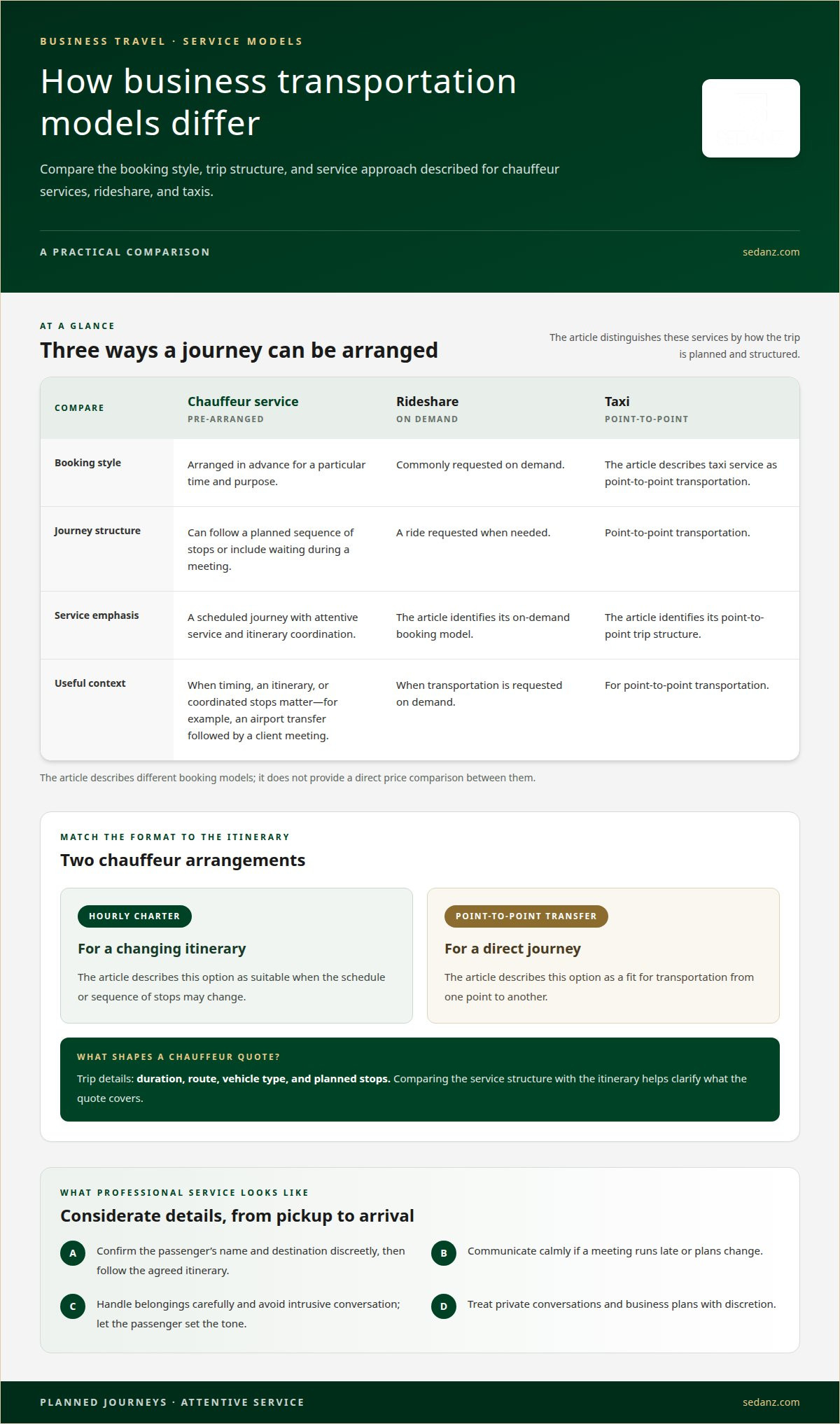
Professional service shows in the details. A chauffeur can confirm the passenger’s name and destination discreetly, follow the agreed itinerary, and respond calmly if a meeting runs late. For a corporate pickup, good protocol means avoiding intrusive conversation, handling belongings carefully, and letting the passenger set the tone. Clear, courteous communication makes transportation feel composed rather than transactional.
Confidentiality matters when passengers discuss negotiations, share documents, or take calls in the vehicle. Professional discretion means not repeating private conversations or drawing attention to a passenger’s business. Some chauffeur services require staff to sign confidentiality agreements. Even without discussing formal paperwork, a chauffeur should treat the passenger’s plans and conversations with care.
A chauffeur service and a rideshare may both provide a vehicle with a driver, but their booking models differ. Chauffeur transportation is arranged in advance for a particular time and purpose, such as an airport transfer followed by a client meeting. Rideshare is commonly requested on demand. Prearranged transportation can be useful when timing and an itinerary matter.
Taxis provide point-to-point transportation, while a professional chauffeur service is designed around a scheduled journey and attentive service. A business traveler may need transportation that waits during a meeting or follows a planned sequence of stops. The right arrangement depends on the occasion and the coordination the schedule requires.
Compare the cost with the service structure, not just the ride. The quote depends on trip details, including duration, route, vehicle type, and planned stops. An Hourly Charter can suit a changing itinerary, while a Point-to-Point Transfer fits a direct journey. Choosing a service that matches the schedule makes the value easier to assess.
Professionalism also appears in how the chauffeur handles changes. If a meeting moves to another address, the driver communicates the adjustment and follows the revised plan. If a passenger prefers quiet before a presentation, respectful service means allowing that space. These considered responses distinguish an occasion-focused journey from transportation arranged solely to reach a destination.
3. Business travel efficiency and professional image
A business journey can become useful working time when a passenger isn’t driving or looking for parking. In a chauffeur-driven vehicle, an executive can review meeting notes, answer emails, or prepare opening remarks. A quiet ride between an airport and an office gives that preparation a place in the schedule. Travel remains travel, but it can also support the work waiting at the destination.
A passenger heading to a client presentation, for example, can use the transfer to review the agenda and confirm key points. Calls and messages are easier to manage when someone else is driving. A private vehicle also offers a composed setting for the journey. The passenger can arrive focused rather than carrying the strain of traffic and parking into the meeting.
Multi-stop corporate travel benefits from an itinerary built around the day’s commitments. A route might connect an airport, a client office, and a hotel, with each stop shared in advance. The chauffeur can follow the agreed sequence and adapt when the schedule changes. This helps reduce the work of coordinating separate trips, especially when appointments are spread across a city.
Reliability matters at transitions: leaving the terminal, reaching a meeting, and moving to the next appointment. Flight tracking and traffic monitoring can support pickup coordination and route decisions. If an inbound flight is delayed, updated flight information helps the service respond. Planning around these transitions makes a demanding travel day easier to manage.
Spending less time behind the wheel also means fewer travel decisions for a business passenger. Instead of choosing a route, finding parking, and watching traffic, the passenger can focus on the next commitment. For a visitor unfamiliar with local roads, a prearranged transfer removes the need to interpret directions while keeping an eye on the meeting schedule.
Arrival contributes to professional image, too. Reaching a client meeting in a clean, well-presented vehicle can create a composed impression before conversation begins. The point isn’t spectacle. It’s choosing transportation suited to the occasion so the passenger can step into the room prepared and on schedule.
To make travel time more useful, share the itinerary, pickup point, and planned stops when booking. For an airport transfer, include the flight details; for a multi-stop day, list each destination in order. Clear information gives the chauffeur a practical plan that aligns with the business schedule.
Professional chauffeured travel is not necessary for every trip. A short, familiar journey with no time-sensitive appointment may not call for a dedicated driver. It is especially useful when airport transfers, multiple meetings, or unfamiliar routes make coordination an important part of the day. The same principle applies when exploring a new destination during corporate retreats or executive downtime, where guided specialists like Island Time Tours handle multi-stop itineraries so travelers can experience the region without the stress of driving.
4. Chauffeur qualities: punctuality, discretion, and professionalism
Punctuality starts with planning around the appointment, not simply aiming for its scheduled time. For an executive attending a morning presentation, the chauffeur considers the pickup point, route, traffic patterns, and arrival location. Professional services use route-planning expertise and live traffic monitoring to help manage the journey. This preparation gives the schedule structure while leaving the driver attentive to changing road conditions.
Traffic can shift quickly, so a professional chauffeur treats the route as a working plan. If congestion builds near a conference venue, the driver can assess an alternative and communicate a change. Local route knowledge helps with practical details, such as choosing an appropriate entrance or avoiding a difficult parking approach. The aim is to manage delays safely, not compensate with hurried driving.
Corporate punctuality depends on coordination as well as driving. A prearranged booking connects the pickup with the passenger’s calendar and purpose. For a client meeting, the itinerary can include the destination and planned stops. If a meeting runs long, communicating the revised pickup plan helps keep the rest of the day organized.
Airport travel calls for attention to flight changes and pickup timing. Sedanz monitors inbound flights and coordinates pickups around updated arrival information. An executive whose flight time shifts can be met according to the revised details rather than the original schedule. This reduces uncertainty at a busy transition and helps the passenger move from the terminal to the next appointment.
Discretion is visible in small choices. A chauffeur can greet a passenger professionally, confirm the destination quietly, and let the executive decide whether conversation is welcome. If a passenger takes a confidential call, attentive service means avoiding interruption and keeping the cabin composed. These behaviors make privacy part of the journey without drawing attention to it.
Professionalism also means handling logistics without making them the passenger’s burden. A chauffeur can navigate traffic, identify a suitable drop-off point, and account for parking access at a meeting venue. For example, when a building has a designated visitor entrance, following the agreed arrival instructions helps the passenger reach the right place efficiently. Clear communication matters if access or timing changes.
When hiring for business travel, punctuality, discretion, polish, and attention to detail are useful qualities to consider. A clean driving record and reliability also matter. The value becomes clear across a full itinerary: a carefully managed pickup, a composed ride, and a well-coordinated arrival. Together, these habits support the executive’s schedule and create a professional impression without turning the journey into a performance.
5. Driver experience and passenger safety
A professional chauffeur supports passenger safety through focused driving, careful responses to hazards, and attention to passenger needs. Smooth braking, appropriate following distance, and calm decisions around changing conditions help create a controlled travel experience. Professional service combines driving with planned responsibility for the journey.
Experience matters because road conditions change. A chauffeur must stay alert, follow applicable road rules, and adapt driving to traffic or adverse weather. The U.S. Government Publishing Office says professional drivers must be qualified and licensed, medically fit, alert, and fully attentive to driving. That focus helps keep the passengers’ safety central throughout the trip.
Licensing requirements can differ by state and city. The U.S. Bureau of Labor Statistics explains that state and local municipalities set additional requirements, and chauffeurs may need a taxi or limousine license. Depending on vehicle type and local regulations, requirements may include a valid driver’s license, a chauffeur-specific license, or a commercial driver’s license.
Insurance and liability terms should be clear before a passenger’s trip. A service should explain in writing what its liability coverage addresses, the applicable limits, and whether vehicle coverage applies during booked passenger transportation. The exact policy and limits depend on the service and jurisdiction, so passengers benefit from clear documentation rather than assumptions about what a policy covers.
Professional experience also shows in how the chauffeur responds to individual preferences. A passenger may prefer a quiet cabin, a particular route, or a planned stop. Sharing trip details lets the chauffeur prepare around those needs. When a flight schedule changes, updated arrival information helps coordinate the pickup and reduce confusion at the airport.
For repeat journeys, a passenger profile can capture practical preferences such as a pickup location, route, or cabin temperature. Used carefully, these details help the chauffeur prepare without asking the passenger to repeat every request. Personal information should be handled discreetly and used to support transportation, not casual conversation.
Safety and personalization work together. A chauffeur can accommodate a requested stop while keeping the route and timing in view. If a passenger asks to adjust the temperature, the driver can do so when safe. Attentiveness can make the journey more comfortable without distracting from driving or the passenger’s purpose.
For business or personal travel, provide accurate pickup, destination, passenger, and flight details when arranging transportation. These particulars help the service coordinate a suitable vehicle and prepare for the itinerary. Arrange a professionally chauffeured journey when attentive driving and personalized service matter to your plans.
Sedanz
Sedanz arranges chauffeured transportation around business schedules and travel needs. Airport Transfers and Point-to-Point Transfers suit planned journeys between key destinations, while Hourly Charters can accommodate days with several appointments. Luxury sedans provide a refined setting for individual business travel.
When passenger safety, punctual coordination, and a composed arrival matter, sharing the itinerary and pickup details helps shape the journey around its purpose. Sedanz provides private chauffeured transportation for executives who value professional service without managing the drive themselves.
Contact Sedanz to discuss your business travel plans.
Make Your Next Business Journey Work Better
The benefits of a professionally trained chauffeur matter most when travel arrangements support the purpose of the day. Before booking, consider what would make the journey easier: a direct transfer between appointments, flexible transportation around a changing schedule, or a calm arrival before an important meeting. Matching the service to your plans makes transportation a considered part of the working day.
Sedanz offers Airport Transfers, Hourly Charters, and Point-to-Point Transfers for business travel with different schedules and itineraries. Share your pickup location, destinations, and planned stops when arranging your journey.
Contact Sedanz to discuss your ride and take the next step toward a more composed business journey.
Frequently Asked Questions
What Makes a Chauffeur Service “Professional”?
A professional chauffeur service combines planned transportation with attentive, consistent conduct. Clear booking details establish the passenger, pickup location, destination, and any special instructions. During the journey, the chauffeur follows the agreed plan, communicates relevant changes, and respects the passenger’s preferences. A traveler preparing for a presentation may value a quiet ride, while a guest unfamiliar with the city may appreciate clear arrival guidance.
How are chauffeurs different from taxis?
Chauffeur transportation is generally arranged in advance around a passenger’s itinerary, while taxi journeys commonly focus on getting from one location to another. A scheduled chauffeur booking can suit a planned sequence, such as a hotel pickup followed by a corporate event. The best fit depends on the trip: a simple, immediate journey may not require the additional planning and service structure of a chauffeur arrangement.
The Cost of Luxury: Is a Chauffeur Worth It?
A private chauffeur can be worthwhile when coordinated travel matters more than the simplest point-to-point ride. Consider whether your day involves several destinations, an important arrival, or time you’d rather spend preparing than driving. The quote depends on the trip details, including route, duration, vehicle type, and planned stops. For a short, uncomplicated trip, another arrangement may suit your needs better.
What Are The Benefits Of Hiring A Private Chauffeur?
A private chauffeur provides dedicated transportation rather than a shared ride. This can help a visiting executive carrying presentation materials or a traveler coordinating several appointments. The passenger can focus on work, calls, or preparation instead of managing the vehicle and route. Share the itinerary and relevant preferences so the journey can be arranged around its purpose.
What Sets Them Apart?
The difference often lies in how transportation is organized around the passenger’s plans. A prearranged chauffeur booking establishes a pickup and destination and can accommodate a planned sequence of stops. A business traveler, for example, can arrange transportation between a hotel, a client office, and an event venue. This structure is useful when coordination matters more than finding a ride for one leg.
What are the main benefits of hiring a professionally trained chauffeur?
The benefits of a professionally trained chauffeur include a considered travel experience, with attentive driving and service suited to the passenger’s purpose. A business traveler might review notes on the way to a meeting; a guest might appreciate calm guidance through an unfamiliar pickup. The value is greatest when timing, comfort, and coordination matter.
How do professional chauffeurs provide better punctuality and reliability?
Professional chauffeurs support punctuality by working from a planned pickup, itinerary, and destination rather than improvising each part of the journey. Passengers can help by sharing accurate pickup details and promptly communicating schedule changes. For an airport arrival, providing flight information helps coordinate the meeting point if plans shift. Traffic and other conditions can still affect timing, so a time-sensitive appointment benefits from thoughtful scheduling.
What customer service and privacy standards do professional chauffeurs follow?
Professional service calls for courteous communication, respect for personal space, and discretion around a passenger’s plans and conversations. A passenger can state practical preferences, such as a quiet cabin or a particular pickup point, without explaining why. The chauffeur should keep interactions focused on the journey and treat private details with care. For sensitive business travel, clear expectations about communication can help establish a comfortable working relationship.