
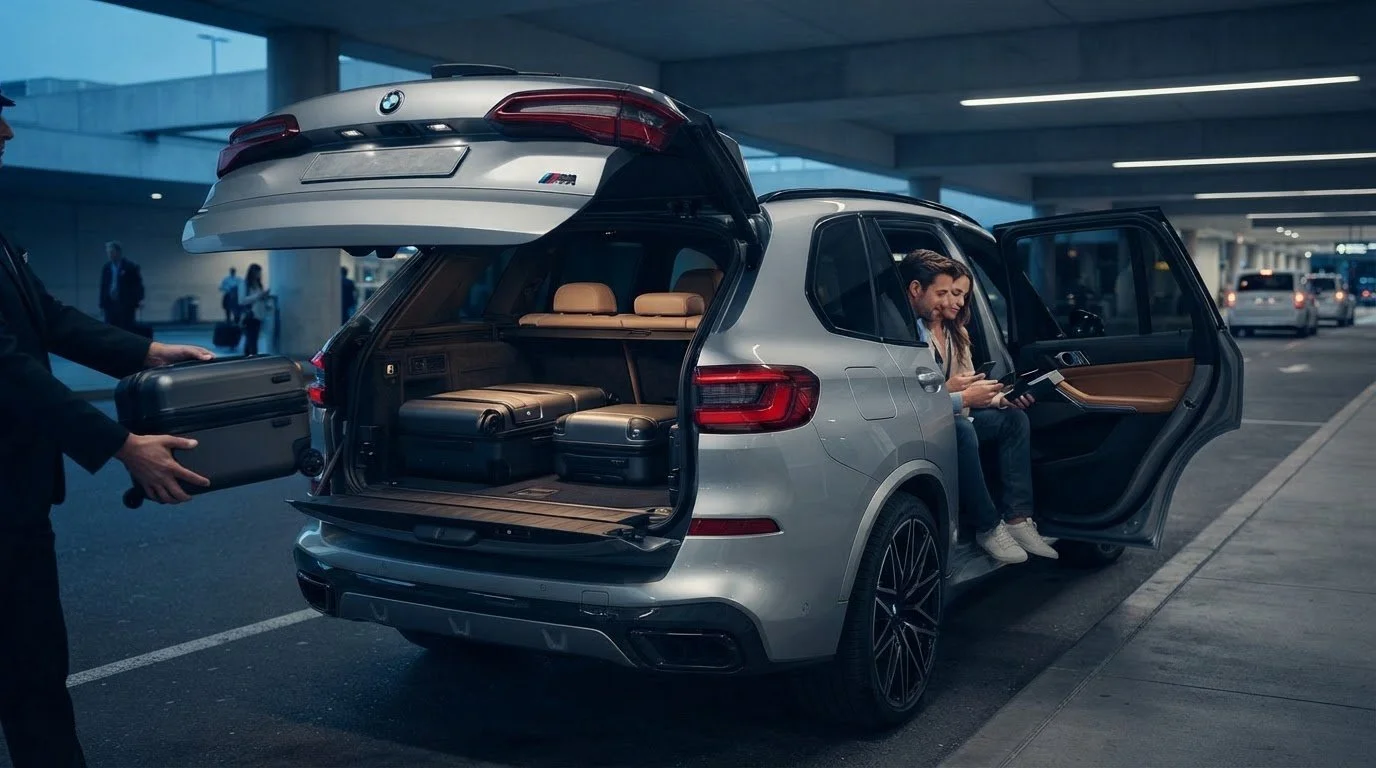
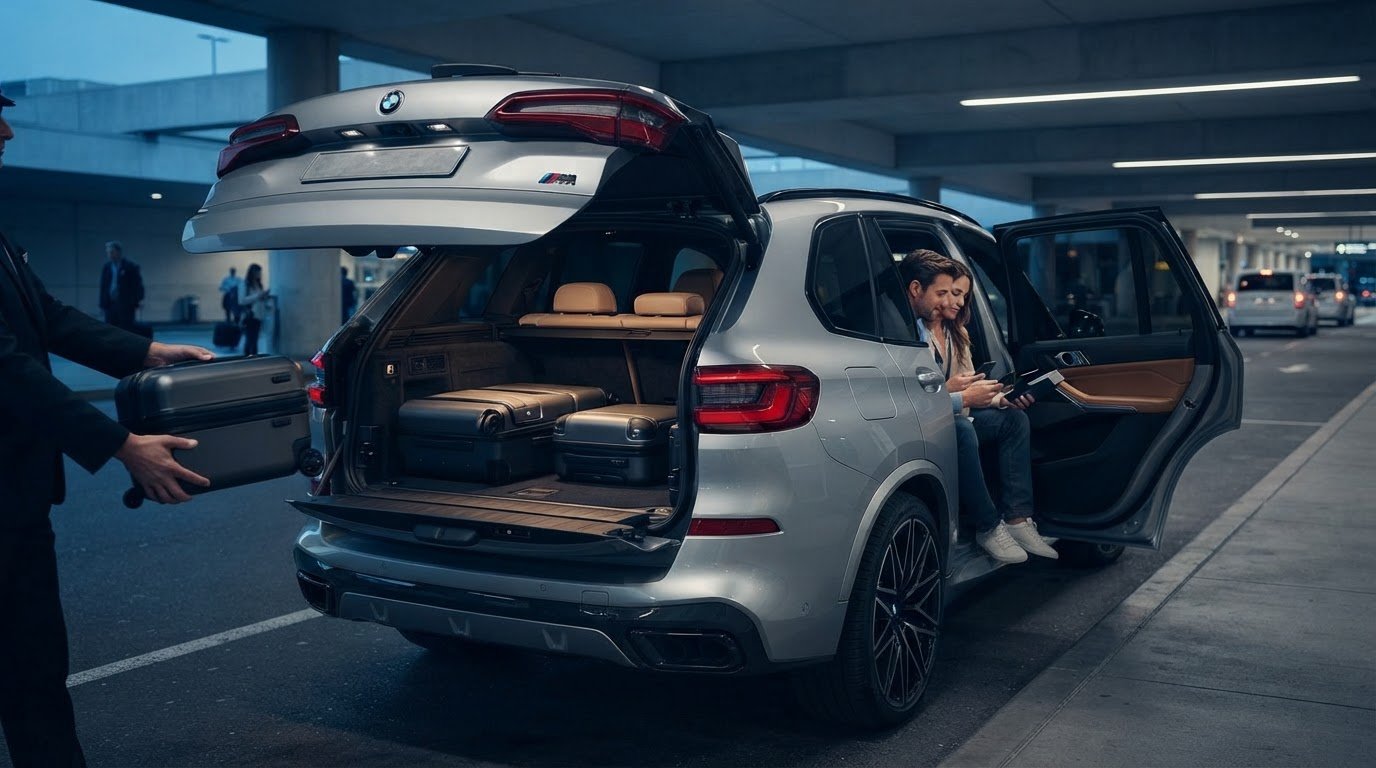
A larger SUV can still leave airport luggage without a practical place to go. The luggage capacity of executive SUVs depends not only on maximum cargo volume, but also on how many seats are occupied and how much room the bags require.
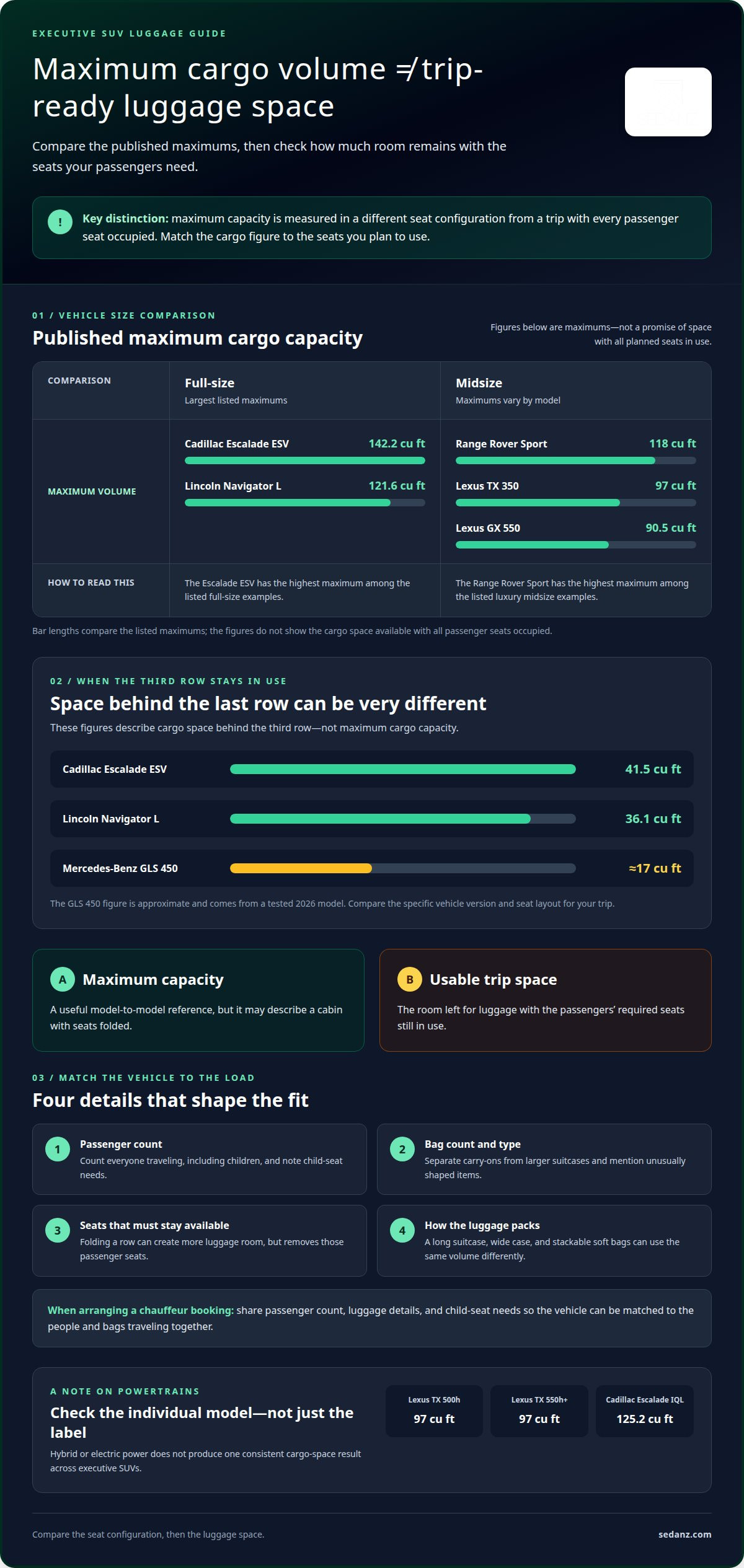
That distinction matters when you’re arranging a chauffeur booking: a figure measured with seats folded doesn’t show how much space is available for passengers and luggage together. For comparison, the 2026 Cadillac Escalade ESV has a maximum cargo capacity of 142.2 cubic feet, while the 2026 Lexus TX 350 has a maximum of 97 cubic feet. Those maximums are useful reference points, not a guarantee that every bag will fit with every row occupied.
This guide compares full-size and midsize executive SUVs, explains how passenger count and seat configuration affect usable luggage space, and shows how to match a vehicle to your airport trip. You’ll also learn what details to share when booking so the vehicle suits the passengers and bags traveling together.
Key Takeaways
- Compare cargo room with the seats you’ll actually use, not only a vehicle’s maximum capacity with rows folded.
- For a third-row trip, cargo space behind that row varies considerably: the 2026 Cadillac Escalade ESV lists 41.5 cubic feet, compared with approximately 17 cubic feet in a tested 2026 Mercedes-Benz GLS 450.
- Match the vehicle to both passenger and bag counts, accounting for luggage shape and how the bags can be stacked.
- Share passenger, luggage, and child-seat needs in your chauffeur booking details to help avoid a vehicle mismatch.
- Use full-size and midsize comparisons as a starting point, then consider which seats must remain available for your group.
Full-size versus mid-size executive SUVs
Full-size luxury SUVs generally prioritize passenger seating and luggage room, while midsize models balance cargo capacity with a smaller footprint. For a useful comparison, look at cargo space with the intended seats in use, not maximum volume alone.
Full-Size Executive SUVs
For the largest published maximums, the 2026 Cadillac Escalade ESV lists 142.2 cubic feet, while the Lincoln Navigator L lists 121.6 cubic feet. Those figures make both substantial-cargo options, but maximum capacity describes a different configuration from a trip with every passenger seat occupied. The Escalade ESV’s listed maximum is higher; usable room depends on the seating layout.
Mid-Size Executive SUVs
Midsize choices can still offer considerable maximum cargo volume. The 2026 Lexus TX 350 lists 97 cubic feet, and the Lexus GX 550 lists 90.5 cubic feet. Cargo capacity comparisons can vary by model and measurement method, so maximum figures may not reflect usable space in practice. These figures help compare models, but they don’t show how much luggage fits while all planned seats remain in use.
BMW X5 and Mercedes-Benz GLE
A direct luggage comparison between the BMW X5 and Mercedes-Benz GLE depends on the cargo configuration being compared. Maximum volume, space behind the second row, and room behind a third row describe different uses. Cargo dimensions also matter: a long suitcase, a wide case, and stacked soft bags can use the same volume differently. Check the stated seat position alongside any capacity figure.
Audi Q7 and Lexus RX
The Audi Q7 and Lexus RX should likewise be compared using the same seating arrangement and measurement method. A cubic-foot rating describes volume, not the cargo area’s length, width, or height. Underfloor storage can affect how luggage fits, but published figures may use different measurement approaches. Automakers may measure to the top of the rear seats or from the floor to the roof.
For the question “Which executive SUVs have the largest luggage capacity?”, the 2026 Cadillac Escalade ESV leads the listed luxury large SUVs at 142.2 cubic feet, followed by the Lincoln Navigator L at 121.6 cubic feet. For the BMW X5, Mercedes-Benz GLE, Audi Q7, and Lexus RX, compare their capacities only in matching seat configurations; volume alone doesn’t settle which suits a particular load.
Hybrid or electric power doesn’t produce one consistent cargo-space result across executive SUVs. The 2026 Lexus TX 500h and TX 550h+ each list 97 cubic feet maximum, while the Cadillac Escalade IQL lists 125.2 cubic feet. Those examples show why the individual model’s published capacity is more useful than its powertrain label.
| Option | Size category | Maximum cargo capacity | Comparison note |
|---|---|---|---|
| Cadillac Escalade ESV | Full-size | 142.2 cubic feet | Largest listed luxury large SUV |
| Lincoln Navigator L | Full-size | 121.6 cubic feet | Below Escalade ESV maximum |
| Land Rover Range Rover Sport | Midsize | 118 cubic feet | Largest listed luxury midsize SUV |
| Lexus TX 350 | Midsize | 97 cubic feet | Maximum volume figure |
| Lexus GX 550 | Midsize | 90.5 cubic feet | Maximum volume figure |
First match the vehicle to your passengers, then compare the cargo room available in that seat configuration and consider the shape of the bags.
Matching vehicle size to passenger and bag count
Choose a vehicle to fit the people and bags traveling together, not by cargo volume alone. Passenger count, occupied seating rows, luggage shape, and child-seat needs all affect usable space. The luggage capacity of executive SUVs is most useful when assessed alongside the cabin layout planned for the journey.
Carry-On Suitcase Capacity
There’s no single carry-on suitcase count that applies to every executive SUV. The fit depends on the vehicle version, occupied seats, and each bag’s shape and size. Soft bags may stack differently from rigid suitcases, so total volume alone won’t tell you how many pieces will fit. Consider the passengers and bags as one load, especially when travelers bring cases of different sizes.
Luggage with All Passenger Seats in Use
With every planned seat occupied, the space behind the last row becomes the deciding area. For example, the 2026 Cadillac Escalade ESV has 41.5 cubic feet behind its third row; the 2026 Lincoln Navigator L has 36.1 cubic feet. These figures describe different models, so match luggage to the actual vehicle version and seating layout.
An executive SUV commonly serves groups of three to six passengers. Full-size models such as the Cadillac Escalade and Lincoln Navigator can accommodate up to six passengers with luggage, but a full cabin leaves less flexibility for bulky cases. For four adults in a full-size luxury SUV, the amount of luggage can be the deciding factor.
For four travelers, available cargo space depends on the vehicle and whether its third row is in use. Folding that row may create more room for luggage, but it also removes those seats. The practical choice is whether to keep seating for every passenger or configure the cabin for a larger load. The luggage capacity of executive SUVs therefore depends on passenger arrangement, not just the model’s maximum figure.
Use these steps to plan the booking details:
- Count every passenger. Include children and note any child-seat requirements.
- List the bags. Separate carry-ons from larger suitcases, and note unusually shaped items.
- Match seats to the group. Identify which rows must remain available during the trip.
- Compare usable cargo space. Focus on the area behind the seats that will stay occupied, not only maximum volume.
Planning this way helps avoid a mismatch between seating and luggage needs. It also gives the driver clear trip details, making pickup and loading easier to manage. Start by describing the whole group and its luggage, rather than choosing by the SUV’s name or size category alone.
A crossover or larger model may have ample maximum cargo volume, but that figure may describe a configuration with seats folded. For an airport trip, consider how the bags will stack and whether their dimensions fit behind the occupied seats. Include passenger count, bag count, and child-seat needs in your trip details.
What is the cargo capacity of popular executive SUVs in cubic feet?
Published maximums range from 57.2 cubic feet for the 2026 BMW X1 to 144.5 cubic feet for the 2026 Chevrolet Suburban and GMC Yukon XL. These figures compare maximum cargo volume, not necessarily the space available with every passenger seat in use.
| 2026 SUV | Category in the listed ranking | Maximum cargo capacity |
|---|---|---|
| Chevrolet Suburban | Large SUV | 144.5 cubic feet |
| GMC Yukon XL | Large SUV | 144.5 cubic feet |
| Cadillac Escalade | Luxury large SUV | 120.5 cubic feet |
| Chevrolet Tahoe | Large SUV | 125.9 cubic feet |
| Ford Expedition MAX | Large SUV | 123.1 cubic feet |
| Jeep Grand Wagoneer L | Large SUV | 116.7 cubic feet |
| Volvo XC90 | Luxury crossover SUV | 85.7 cubic feet |
| Mercedes-Benz GLS | Luxury crossover SUV | 84.7 cubic feet |
| BMW X3 | Luxury small SUV | 67.1 cubic feet |
| INFINITI QX50 | Luxury small SUV | 65.1 cubic feet |
| Jaguar F-PACE | Luxury small SUV | 70.4 cubic feet |
The table shows a clear difference between extended large SUVs and smaller luxury models. The Suburban and Yukon XL each list 144.5 cubic feet maximum, while the BMW X3 lists 67.1 cubic feet. That gap helps identify a size class, but it doesn’t tell you how many bags fit alongside passengers.
Model names matter, too. The 2026 Cadillac Escalade lists 120.5 cubic feet, while the larger Escalade ESV lists 142.2 cubic feet. Likewise, the Ford Expedition MAX and Jeep Grand Wagoneer L have listed maximums of 123.1 and 116.7 cubic feet. A longer model can offer a different cargo-volume figure, so compare the exact version rather than relying on a nameplate alone.
Small luxury SUVs span a narrower range in these examples. The 2026 Jaguar F-PACE lists 70.4 cubic feet, compared with 65.1 for the INFINITI QX50 and 67.1 for the BMW X3. Those maximums help shortlist models, but they don’t show the load’s shape or the space left with seats occupied.
Measurement methods also affect comparisons. Automakers may measure cargo space to the top of the rear seats or from the floor to the roof, so reported capacities may not use a consistent method. Treat each figure as a model-specific reference, then compare the seat configuration and usable cargo area for your trip.
At the smaller end, the 2026 luxury subcompact SUV with the most cargo space is the Volvo XC40, with a maximum capacity of 57.5 cubic feet. Car and Driver's full-size luxury SUV rankings use roughly 200 data points, including cargo space. For an airport trip, compare all passengers’ bags with the cargo area behind the seats they will use, and consider bag shape and stacking.
How much luggage fits behind the third row in executive SUVs?
With all three rows occupied, luggage must fit in the cargo area behind the third row. Published figures show how sharply that space can vary: the 2026 Cadillac Escalade ESV lists 41.5 cubic feet, and the 2026 Lincoln Navigator L lists 36.1 cubic feet. A tested 2026 Mercedes-Benz GLS 450 had approximately 17 cubic feet behind its third row.
Those figures are more useful for a full passenger load than maximum cargo ratings. Maximum capacity can include space created by folding rear seats, which isn’t available when those seats carry passengers. For example, the GLS 450’s approximately 17 cubic feet behind the third row is a more relevant reference for a trip using all rows than its 84.7-cubic-foot maximum.
The comparison also shows why “full-size” alone doesn’t settle the luggage question. The Escalade ESV’s listed space behind the third row exceeds the Navigator L’s, while the tested GLS 450 has less. The exact model and seat configuration matter; a vehicle’s overall category cannot predict the available space at the back.
Assess the planned load in practical terms, not only by its total volume. A broad suitcase may take up floor space that could fit several compact bags, while soft-sided luggage can be easier to arrange around other cases. A stroller or another bulky item can also affect the fit. Keep the third-row seats in their intended position when assessing the cargo area available for luggage.
For airport travel, use this sequence to plan around the rear cargo area:
- Count passengers and bags. Include every traveler using the third row and each piece of luggage.
- Separate bulky items. Identify large suitcases, strollers, or unusual shapes that may limit stacking.
- Compare the right figure. Use cargo space behind the third row, not maximum capacity with seats folded.
- Consider the arrangement. Think about how cases can sit together without blocking the space needed by other bags.
For example, a group keeping every seat in a 2026 Escalade ESV available should focus on its 41.5 cubic feet behind the third row. A trip using a 2026 GLS 450’s third row should instead use approximately 17 cubic feet as its reference. These figures describe cargo volume, not an exact suitcase count; luggage dimensions and shapes affect how the space works in practice.
Before an airport journey, share the passenger count, bag count, and any bulky items in your trip details. This makes it easier to consider the seating arrangement and luggage load together, rather than relying on a maximum-volume figure based on a different cabin configuration.
How much cargo space is available with the rear seats folded?
Folding rear seats can increase cargo room, but published maximums describe a different layout from a fully occupied cabin. For the 2026 Kia Sorento, total cargo capacity reaches 75.5 cubic feet with both the second and third rows folded. That figure helps explain the effect of seat configuration, rather than the space available when passengers use those rows.
Among 2026 luxury models, the Cadillac Escalade IQL lists a maximum of 125.2 cubic feet. The Buick Enclave lists 97.5 cubic feet as the highest maximum among the luxury crossover SUVs in the provided comparison. These figures offer useful reference points, but each describes a maximum-capacity setup, not a passenger-and-luggage arrangement.
For a trip, identify which seats need to remain available before using a folded-seat capacity as a guide. Folding the third row changes the cargo area while preserving the front rows; folding additional rows changes it further but removes those passenger seats. The 2026 Sorento’s 75.5-cubic-foot figure specifically applies with both rear rows folded, so it shouldn’t be treated as its capacity with those seats occupied.
Capacity figures also don’t show whether a particular suitcase will fit through the opening or sit neatly in the available space. A long case, a tall item, and several compact bags use cargo space differently. Automakers may measure from the floor to the roof or only to the top of the rear seats, making direct comparisons less straightforward.
Use these steps to interpret a folded-seat maximum for your journey:
- Set the passenger layout. Decide which seats must remain in use, including the third row.
- Read the matching configuration. Distinguish capacity with one row folded from maximum capacity with multiple rows folded.
- Consider bag dimensions. Account for long, tall, or rigid pieces that may not fit the cargo area’s shape.
- Plan around the actual load. Compare luggage with the space behind the seats that passengers will occupy.
The Cadillac Escalade IQL’s 125.2-cubic-foot maximum and the Kia Sorento’s 75.5-cubic-foot figure illustrate why model and seat position matter. Neither number provides an exact suitcase count. Bag shape, stacking, and the seats kept upright determine how the available area works for a specific load.
For an airport trip, share the passenger count and luggage details when arranging a point-to-point transfer. The seat configuration and the bags traveling with the group are more useful planning details than a folded-seat maximum alone.
Sedanz
Sedanz helps travelers turn passenger and luggage details into a considered chauffeur booking. Share how many people are traveling, which seats need to remain in use, and the number and type of bags. These details help guide the choice of a suitable vehicle for an airport journey, point-to-point trip, or hourly charter. Sedanz offers Airport Transfers, Point-to-Point Transfers, Hourly Charters, Luxury SUV Service, Mercedes Sprinter Van Service, and Luxury Sedan Service. The right option depends on the group’s seating needs and luggage arrangement, not maximum cargo volume alone. For a journey where luggage and passenger space both matter, contact Sedanz to discuss your trip.
Make the Journey Work as Smoothly as the Arrival
Choosing the right vehicle is part of a well-planned journey, not the whole plan. Consider how the trip will unfold: where passengers will meet, when luggage needs loading, and whether the route includes stops before the destination. A clear sequence can make the transition from travel to arrival smoother, especially when several people are coordinating their plans.
Use what you’ve learned about the luggage capacity of executive SUVs to plan around the actual journey, rather than choosing by appearance or maximum cargo volume alone. A thoughtful plan accounts for passenger comfort and luggage handling from pickup through drop-off. Sedanz offers Airport Transfers, Hourly Charters, and Point-to-Point Transfers for different travel needs.
Contact Sedanz to plan your ride and take the next step toward a well-coordinated journey.
Frequently Asked Questions
Can a luxury SUV handle an airport run with a lot of luggage?
Yes, a luxury SUV can suit an airport trip with substantial luggage when its seating arrangement and cargo area fit the traveling group. For example, a family traveling with a stroller and suitcases should include both in its trip details, rather than counting only bags. Sedanz offers Airport Transfers and Luxury SUV Service for travelers who want a planned, chauffeured airport journey.
Which Luxury SUV Is Best for Executive Transport?
The best vehicle depends on the executive group’s passenger count, luggage, and journey requirements, not a single model name. A small party with compact bags has different needs from colleagues carrying presentation cases and travel luggage. Sedanz offers Luxury SUV Service for chauffeured executive transportation. Share the group’s needs and itinerary when arranging the ride so the booking can account for both passengers and their belongings.
Do executive SUV cargo-capacity figures include underfloor storage?
Cargo figures use different measurement approaches, such as measuring to the top of the rear seats or from the floor to the roof. Underfloor storage can also affect how luggage fits.